📝 Paper Summary
User modeling
RAG-based personalization
The paper enables LLMs to make personalized dietary recommendations by reasoning over user-specific causal graphs derived from longitudinal data, simulating interventions before responding.
Core Problem
LLMs rely on population-level correlations and lack structured representations of individual physiological dynamics, often leading to generic or unsafe dietary advice that ignores personal metabolic responses.
Why it matters:
- Generic advice fails in healthcare contexts where individual variability (e.g., glucose response to specific foods) determines safety and efficacy
- Current personalization methods (RAG, prompt engineering) often encode personalization implicitly without modeling the causal structure of how inputs affect personal outcomes
- Blindly following generic 'healthy' guidelines (e.g., eat fruit) can be harmful to specific individuals with unique sensitivities (e.g., glucose spikes from specific fruits)
Concrete Example:
A standard LLM might recommend almond milk or eggs as generally healthy options. However, for a user with specific metabolic sensitivities, these might cause glucose spikes or fail to prevent them, which a generic model cannot predict without access to the user's personal causal history.
Key Novelty
Personalized Causal Graph Reasoning
- Constructs a unique causal graph for each user from longitudinal data (e.g., CGM, food logs) representing how specific nutrients affect their health outcomes (e.g., glucose)
- LLM traverses this personal graph to find causal pathways impacting a user's goal, rather than relying on general semantic knowledge
- Includes a simulation/verification step where the LLM uses the graph's causal weights to mathematically estimate the effect of a proposed food before recommending it
Architecture
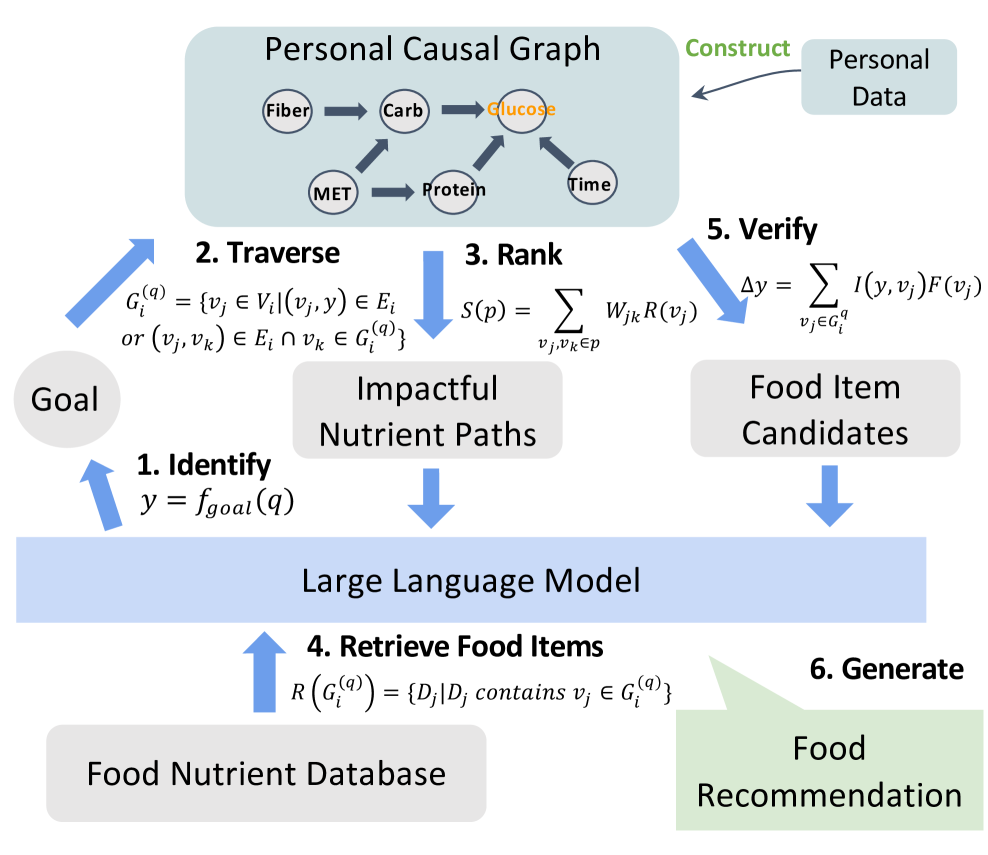
Workflow of the Personalized Causal Graph Reasoning framework for dietary recommendations.
Evaluation Highlights
- Reduces postprandial glucose iAUC (incremental Area Under Curve) across 30-min, 1-hour, and 2-hour windows compared to user's historical habits
- Counterfactual simulations demonstrate a positive Mean Glucose Reduction (MGR), indicating recommendations theoretically outperform habitual choices
- LLM-as-a-judge evaluations confirm improved personalization quality compared to baseline approaches
Breakthrough Assessment
7/10
Strong application of causal reasoning to personalization, moving beyond simple retrieval. However, evaluation relies heavily on simulated counterfactuals rather than a live clinical trial.