📝 Paper Summary
Multimodal Recommendation
LLM-Enhanced Recommendation
Graph Neural Networks (GNN) for RecSys
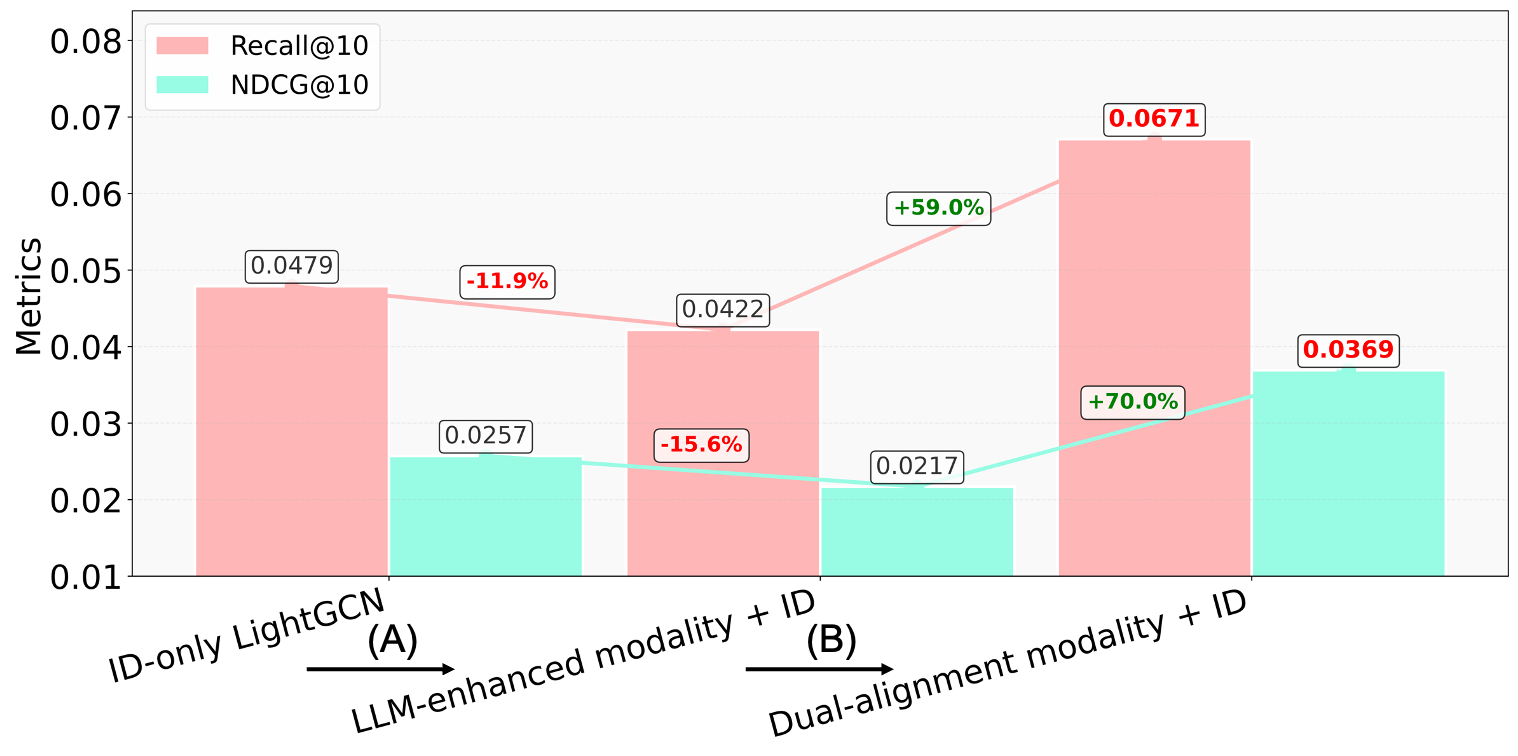
RecGOAT bridges the semantic gap between Large Model knowledge and recommendation ID signals using dual-granularity alignment: instance-level contrastive learning and distribution-level optimal adaptive transport.
Core Problem
Existing methods fail to align the rich, general semantic knowledge of Large Models (LLMs/LVMs) with the sparse, specific ID-based signals used in collaborative filtering.
Why it matters:
- Semantic heterogeneity prevents recommendation systems from fully leveraging the reasoning and world knowledge capabilities of Large Models
- Current alignment techniques are limited to local instance-level matching, missing global distribution-level patterns essential for robust cross-modal understanding
- Misaligned representations lead to suboptimal performance, particularly in large-scale scenarios where ID sparsity is high and semantic understanding is crucial
Concrete Example:
A generative Large Model understands an item as a 'vintage leather jacket' with specific visual attributes, while a recommendation system sees it as 'ID: 49201' linked to user clicks. Without alignment, the model cannot transfer the semantic understanding of 'vintage' to similar items that 'ID: 49201' users might like but haven't clicked yet.
Key Novelty
Graph Optimal Adaptive Transport (RecGOAT)
- Treats modal alignment as an optimal transport problem, moving the distribution of LLM-enhanced semantic features to match the distribution of collaborative ID features
- Uses a dual-granularity approach: instance-level contrastive learning for local discriminability and distribution-level transport for global semantic consistency
- Introduces adaptive learnable parameters into the transport matrix, allowing the geometric alignment to be fine-tuned by downstream recommendation tasks
Architecture
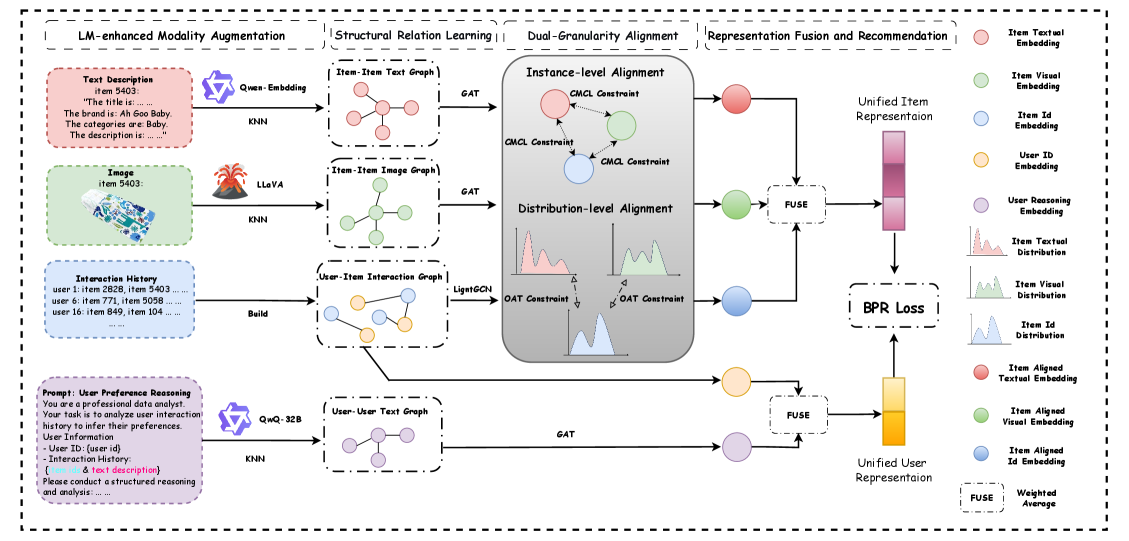
The overall architecture of RecGOAT, illustrating the data flow from LLM-enhanced feature extraction to dual-granularity alignment and final prediction.
Evaluation Highlights
- Outperforms state-of-the-art baselines on three public datasets (Amazon-Baby, Amazon-Sports, Tiktok) across Recall@20 and NDCG@20 metrics
- Achieves 1.48% improvement in CTR and 1.63% in GMV in online A/B testing on a large-scale advertising platform
- Consistent performance gains over LLM-based competitors like TALLRec and various multimodal GNN baselines
Breakthrough Assessment
7/10
Solid theoretical grounding with Optimal Transport for distribution alignment, backed by both extensive offline benchmarks and real-world industrial deployment. Addresses a critical semantic gap in current LLM-RecSys integration.