School of Computer Science and Technology, Beijing Jiaotong University
arXiv
(2024)
RecommendationAgentMemoryP13N
๐ Paper Summary
User Simulation for Recommender SystemsConversational Recommender Systems (CRS)
CSHI is a modular, plugin-based user simulator framework that uses LLMs to generate realistic, controllable, and scalable user interactions for evaluating conversational recommender systems while preventing data leakage.
Core Problem
Existing LLM-based user simulators rely on 'single-prompt' templates that are hard to control and often leak ground-truth item names into the simulator's input, making evaluations unrealistic.
Why it matters:
Evaluating Conversational Recommender Systems (CRS) with real humans is prohibitively expensive and time-consuming.
Template-based simulators lack conversational flow, while current LLM simulators suffer from 'data leakage' (knowing the target item too early), rendering evaluation metrics unreliable.
Researchers need fine-grained control over simulator personalities and preferences to test diverse scenarios, which single-prompt methods cannot easily provide.
Concrete Example:In current simulators, the prompt often includes the target movie name (e.g., 'Target: Matrix') to guide the LLM. The LLM might accidentally mention 'Matrix' or its specific details (runtime 136 mins) before the recommender actually suggests it, creating an unrealistic shortcut.
Key Novelty
Plugin-Managed Phased Simulation Framework (CSHI)
Decomposes user simulation into distinct stages (Profile Init, Preference Init, Message Handling), managed by a central plugin manager rather than a single giant prompt.
Introduces a 'known vs. unknown' preference split: the simulator knows its general tastes (known) but discovers specific latencies (unknown) only when the CRS reveals them, mimicking real discovery.
Anonymizes sensitive item attributes (e.g., changing 'released June 1, 2012' to 'the 2010s') to prevent the simulator from leaking unique identifiers during conversation.
Architecture
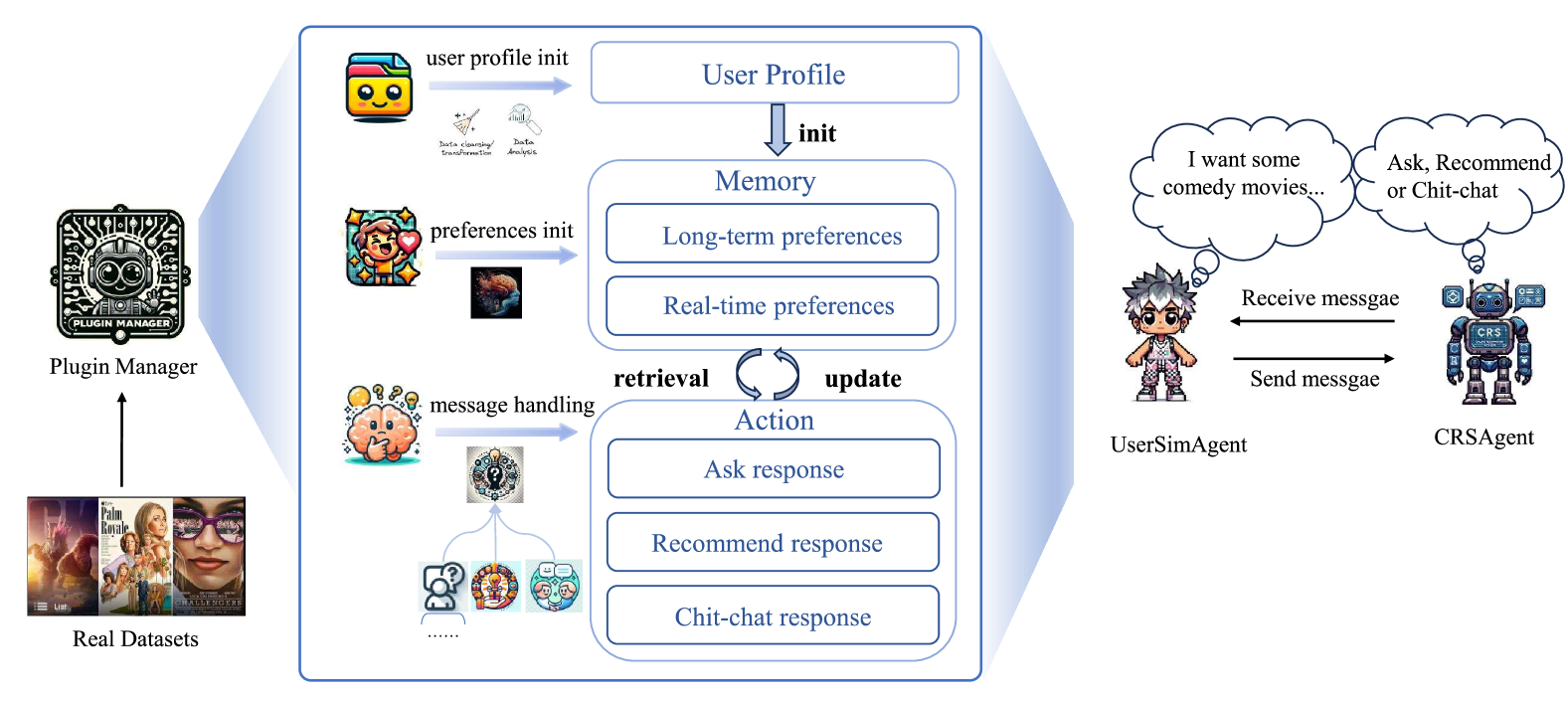
The overall framework of CSHI, illustrating the interaction between the User Simulator and the CRS.
Evaluation Highlights
CSHI-based simulator produces feedback closely mirroring real users, facilitating reliable assessment of CRS.
The framework supports both manual profile editing (Human-Involved) and automated LLM generation, adapting to diverse conversational settings.
Successfully demonstrates scalability by allowing expansion/reduction of plugins for personalized requirements.
Breakthrough Assessment
7/10
Addresses the critical 'data leakage' flaw in LLM-based user simulation with a sensible architectural change (plugin system). While performance metrics are qualitative/demonstrative, the structural contribution to CRS evaluation is significant.
โ๏ธ Technical Details
Problem Definition
Setting: Simulating a user u interacting with a Conversational Recommender System (CRS) to evaluate the CRS's performance.
Inputs: User interaction history, target item metadata, and real-time messages from the CRS.
Outputs: Natural language responses (Ask, Recommend, Chit-chat) and preference feedback.
Pipeline Flow
User Profile Init: Generate/load user personality and history
Preferences Init: Categorize preferences into Long-term, Real-time (Known), and Real-time (Unknown)
Message Handling: Interpret CRS intent and generate response via specialized plugins
System Modules
User Profile Init (Initialization)
Establish agent personality and history
Model or implementation: LLM (unspecified specific version)
User Preferences Summary Plugin (Initialization)
Extract long-term tastes from history
Model or implementation: LLM
Real-Time Preference Generation Plugin
Generate session-specific preferences while preventing leakage
Plugin-based architecture managing simulation stages independently rather than a monolithic prompt.
Explicit memory separation of 'Known' vs 'Unknown' preferences to simulate discovery and prevent leakage.
Anonymization layer for sensitive item attributes (dates, exact runtimes) within the memory generation process.
Modeling
Base Model: LLM (Specific model architecture not explicitly reported in paper text)
Compute: Not reported in the paper
Comparison to Prior Work
vs. Single-Prompt LLM Simulators: CSHI uses a modular plugin manager to separate preference generation from response generation, preventing data leakage [cited in paper].
vs. Agent4Rec: CSHI adopts the preference summary approach but extends it with real-time known/unknown splitting for conversational contexts [cited in paper].
vs. RecAgent: CSHI focuses specifically on the *conversational* data leakage problem rather than general social simulation [cited in paper].
Limitations
The paper provides a framework description and case studies but lacks extensive quantitative benchmarking against other simulators.
Specific LLM backbones and computational costs are not detailed.
The effectiveness of the 'unknown' preference discovery relies heavily on the CRS providing high-quality explanations to trigger the update.
Code is publicly available at https://github.com/zlxxlz1026/CSHI. The paper describes the plugin logic but lacks specific LLM hyperparameters (temperature, specific base model version used for experiments).
๐ Experiments & Results
Evaluation Setup
Simulation of user interaction in conversational recommendation scenarios (specifically mentioned: movie domain).
Benchmarks:
Case Studies (Qualitative Analysis) [New]
Metrics:
Qualitative assessment of response realism
Ability to maintain conversation flow
Effective prevention of data leakage (implied)
Statistical methodology: Not explicitly reported in the paper
Main Takeaways
The framework effectively segregates 'known' and 'unknown' preferences, allowing the simulator to 'discover' interests during the conversation rather than knowing them a priori.
The plugin architecture allows for flexible switching between 'ask', 'recommend', and 'chit-chat' modes, maintaining natural conversation flow.
Anonymization of sensitive attributes (like release dates) prevents the simulator from giving away the target item identity through unrealistic specific details.
๐ Prerequisite Knowledge
Prerequisites
Conversational Recommender Systems (CRS)
Large Language Models (LLMs) for simulation
Prompt Engineering
Key Terms
CRS: Conversational Recommender Systemโa system that elicits user preferences through natural language dialogue to make recommendations.
Single-prompt: The standard approach where the entire user simulation instruction is fed to the LLM in one context window, leading to control issues.
Data Leakage: In simulation, when the user agent inadvertently reveals knowledge of the target item (the 'ground truth') that a real user wouldn't know yet.
Known vs. Unknown Preferences: A distinction where 'known' are explicit user desires (e.g., 'comedy'), and 'unknown' are latent preferences elicited only when the system presents specific items.
Plugin Manager: The core architectural component of CSHI that orchestrates different specialized modules (plugins) for different stages of the simulation.