📝 Paper Summary
User modeling
Mental Health NLP
Clinical Decision Support
MHINDR aggregates unstructured social media history into clinical profiles by separating temporal symptom progression from psychological features to generate DSM-5 aligned diagnoses and recommendations.
Core Problem
Social media data is noisy and unstructured, making it difficult to extract the temporal context (duration, frequency) required for accurate clinical diagnosis according to standardized criteria like DSM-5.
Why it matters:
- Mental health professionals lack tools to efficiently process vast patient-generated text for insights
- Existing methods often classify posts into disorders without capturing the temporal dynamics (e.g., how long symptoms have persisted) crucial for distinguishing between transient distress and clinical disorders
- Subjective manual judgments and limited data integration hinder personalized treatment planning
Concrete Example:
A user might post about 'feeling down' and 'losing sleep' in separate posts months apart. A standard sentiment classifier might just label these as 'negative', missing the progression. MHINDR aggregates these to identify a '6-month duration' of symptoms (temporal), maps them to 'insomnia' and 'depressive mood' (DSM-5), and suggests a diagnosis of Major Depressive Disorder.
Key Novelty
Dual-Stream Clinical Profiling (MHINDR)
- Separates feature extraction into 'Non-temporal' (symptoms, triggers, tone) and 'Temporal' (duration, frequency, recurrence) streams to explicitly capture the time-dimension required by DSM-5
- Aggregates fragmented posts into a cohesive user chronology before feeding them to an LLM for final diagnosis, ensuring the model sees the full progression of the condition
Architecture
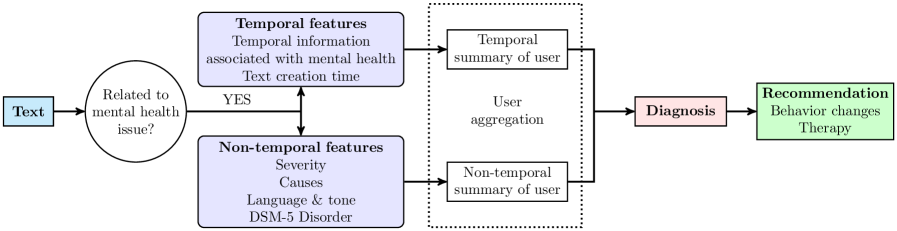
The MHINDR framework workflow from data ingestion to final recommendation.
Evaluation Highlights
- Generated comprehensive temporal summaries for 92.46% of users, successfully aggregating sparse time clues despite only 10.65% of individual posts containing explicit temporal references
- Identified Cognitive Behavioral Therapy (CBT) as the appropriate intervention for 92.5% (185/200) of profiled users based on automated DSM-5 analysis
- Categorized 67.4% of analyzed social media entries as 'Severe' and 19.4% as 'Moderate', demonstrating the framework's ability to stratify risk levels without human intervention
Breakthrough Assessment
6/10
Proposes a solid framework for integrating DSM-5 criteria with LLMs, specifically addressing the temporal aspect of diagnosis. However, the evaluation lacks ground-truth validation against human clinicians, limiting claims of diagnostic accuracy.