📝 Paper Summary
Display Advertising
Generative Retrieval
LLM Recommendation
LEADRE integrates Large Language Models into a large-scale industrial ad retrieval system by using semantic IDs, intent-aware prompting, and a hybrid latency-tolerant deployment architecture.
Core Problem
Traditional ID-based ad retrieval methods underutilize rich ad content (text/descriptions) and struggle to capture implicit user intent or diverse interests in sparse behavior scenarios.
Why it matters:
- ID-based methods create 'information cocoons' by reinforcing existing preferences and lacking novelty.
- Industrial display advertising lacks explicit queries, making it difficult to infer intent compared to search advertising.
- Deploying LLMs at scale (tens of billions of requests) faces massive latency and cost constraints.
Concrete Example:
In ID-based systems, a user with sparse history might only see ads similar to past clicks, missing relevant long-tail ads. LEADRE uses LLMs to reason over user profiles and cross-domain behaviors (e.g., news reading) to generate semantically relevant ad candidates that traditional collaborative filtering misses.
Key Novelty
Multi-Faceted Knowledge Enhanced LLM Retrieval (LEADRE)
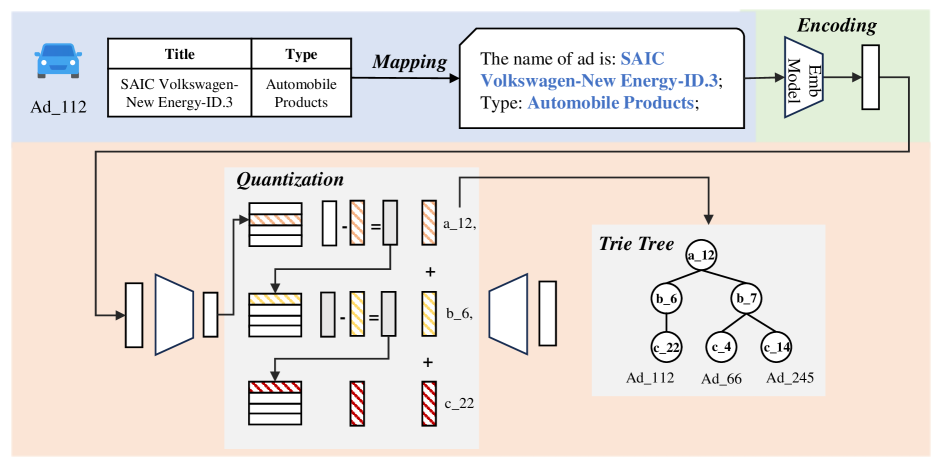
- Uses Semantic IDs (S-IDs) derived from ad text (via RQ-VAE) to bridge the gap between natural language generation and fixed ad inventories.
- Constructs intent-aware prompts incorporating long-term/short-term interests and cross-domain behaviors (news, video) to mitigate data sparsity.
- Employs a hybrid deployment strategy where LLMs generate candidates asynchronously (latency-tolerant) while a lightweight retrieval service fetches them in real-time.
Architecture
The overall LEADRE framework illustrating the three core modules: Intent-Aware Prompt Engineering, Advertising-Specific Knowledge Alignment, and Latency-Aware Model Deployment.
Evaluation Highlights
- +1.57% GMV (Gross Merchandise Value) lift on Tencent WeChat Channels in online A/B testing.
- +1.17% GMV lift on Tencent WeChat Moments in online A/B testing.
- Significant improvement in HitRatio and NDCG metrics in offline experiments compared to SASRec and Text-based baselines.
Breakthrough Assessment
8/10
High score for successful industrial deployment handling billions of requests. While LLM retrieval exists in research, deploying it online in high-throughput ad systems with a hybrid latency architecture is a significant engineering and practical contribution.