📝 Paper Summary
Fairness in Recommender Systems
LLM Agents for Data Annotation
LLMFOSA improves recommender system fairness without requiring users' sensitive data by using multi-persona LLM agents to infer attributes and correcting for inference noise via confusion modeling.
Core Problem
Training fair recommender systems typically requires access to users' sensitive attributes (e.g., gender, race), which are often unavailable due to privacy concerns or anonymity.
Why it matters:
- Unfairness leads to unequal treatment of user groups (e.g., gender bias in job recommendations) and harms platform reputation
- Existing methods that infer sensitive attributes from behavior often rely on spurious correlations (like gradient proxies) that are unreliable and noisy
- Standard fairness optimization fails when the estimated sensitive distribution is suboptimal or incorrect
Concrete Example:
On an anonymous platform like Hush or Spotify, a model might bias job recommendations against female users based on behavioral patterns. Since the platform collects no gender data, standard fairness constraints cannot be applied, and simple inference models might mislabel users, reinforcing the bias.
Key Novelty
LLM-Enhanced Framework for Fair Recommendation withOut Sensitive Attributes (LLMFOSA)
- Uses a 'Persona Editor' to generate diverse LLM agents (e.g., anthropologist vs. sociologist) that infer sensitive attributes from user behavior, mitigating single-perspective bias
- Introduces 'Confusion-Aware Sensitive Representation Learning' which models the probability of each agent's misclassification (confusion matrix) to learn robust fairness representations despite noisy inferences
Architecture
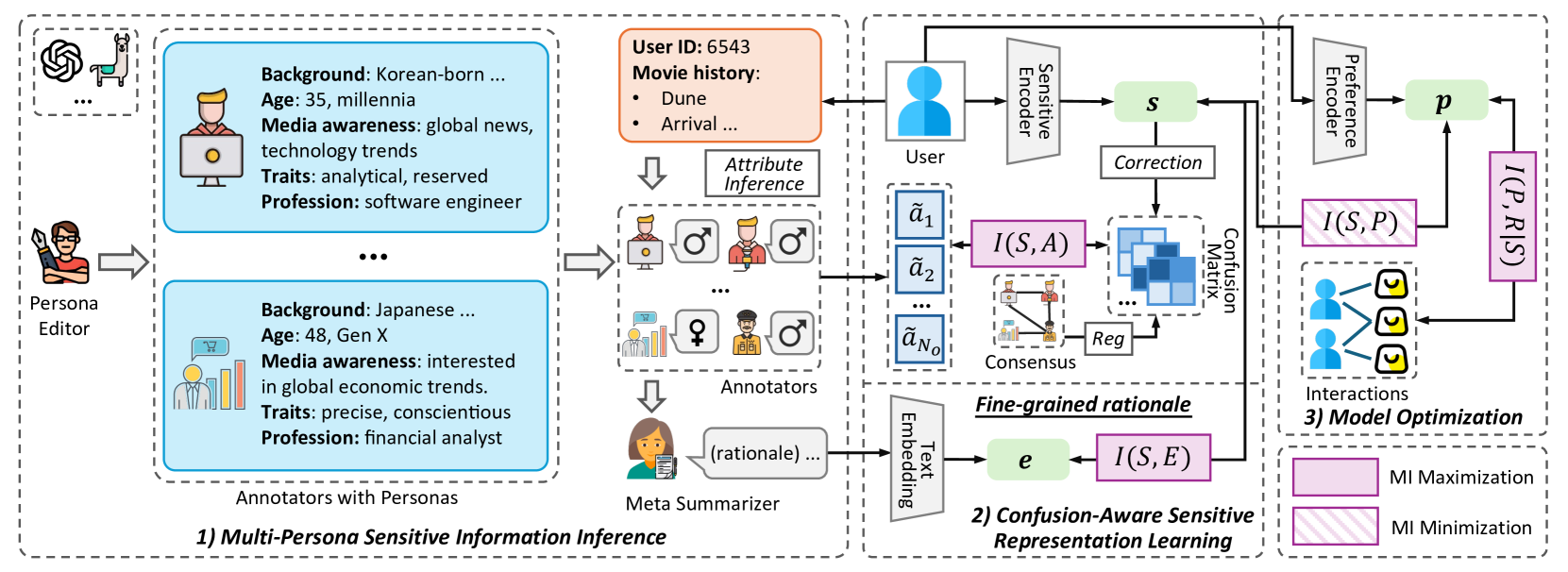
The overall LLMFOSA framework, illustrating the two-stage process: (1) Multi-Persona Sensitive Information Inference and (2) Confusion-Aware Sensitive Representation Learning.
Breakthrough Assessment
7/10
Addresses a critical practical gap (fairness without ground-truth sensitive data) using a novel confusion-aware multi-agent approach. However, reliance on LLM inference for sensitive traits introduces new ethical/accuracy complexities.