📝 Paper Summary
Graph-based Recommendation Systems
LLM-based Data Augmentation
VoteGCL augments graph recommendation data by using Large Language Models to repeatedly rerank candidate items and aggregating results via majority voting to ensure high-confidence synthetic interactions.
Core Problem
Graph-based recommendation systems suffer from data sparsity and popularity bias, while existing LLM-based augmentation methods produce inconsistent results due to stochastic generation and misaligned embeddings.
Why it matters:
- Data sparsity limits the effectiveness of collaborative filtering, leading to poor recommendations for users with few interactions (cold start)
- Directly using LLM-generated embeddings often causes distributional shifts that degrade performance when integrated with collaborative signals
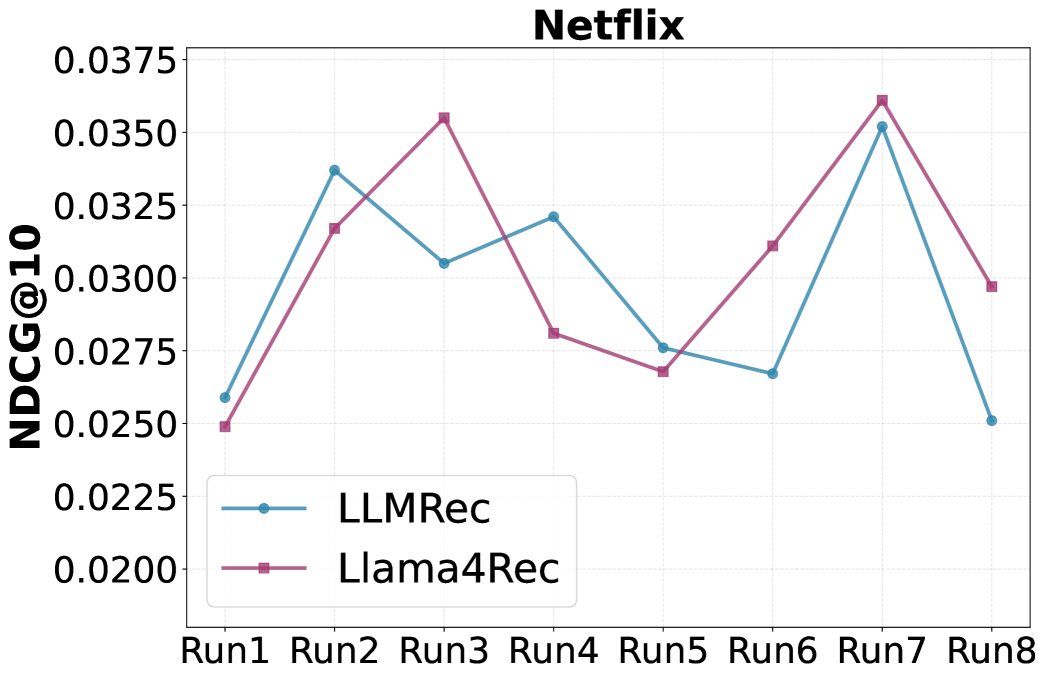
- Existing LLM augmentation is unstable; single inference runs yield fluctuating results (e.g., varying NDCG scores on Netflix) due to the probabilistic nature of LLMs
Concrete Example:
When prompting an LLM to predict user preferences, one run might rank 'Inception' high while another ranks it low due to randomness. Existing methods using a single pass introduce noise. VoteGCL runs the ranking N times; if 'Inception' appears at the top in most runs, it is reliably added as a synthetic edge, reducing noise.
Key Novelty
VoteGCL: Majority-Voting LLM-Rerank Augmentation
- Reformulates augmentation as a reranking task where an LLM orders candidate items multiple times, aggregating results via a simplified Reciprocal Rank Fusion (RRF) to filter out stochastic noise
- Integrates these high-confidence synthetic interactions into a Graph Contrastive Learning framework, aligning the original and augmented graph views to mitigate popularity bias without needing complex embedding alignment
Architecture
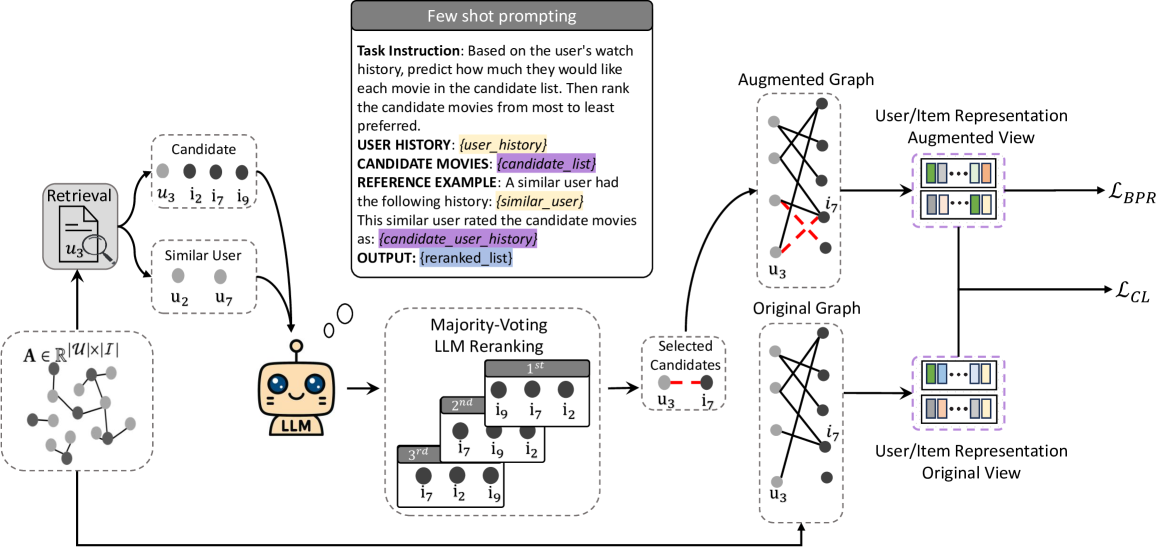
The overall VoteGCL framework, illustrating the two-stage process: Data Augmentation via Majority-Vote Reranking and Graph Contrastive Learning.
Evaluation Highlights
- Outperforms state-of-the-art baselines (e.g., LightGCN, SimGCL) on Netflix dataset with +5.79% improvement in NDCG@20
- Reduces popularity bias significantly, lowering popularity consumption by ~40% on the Amazon Book dataset compared to LightGCN
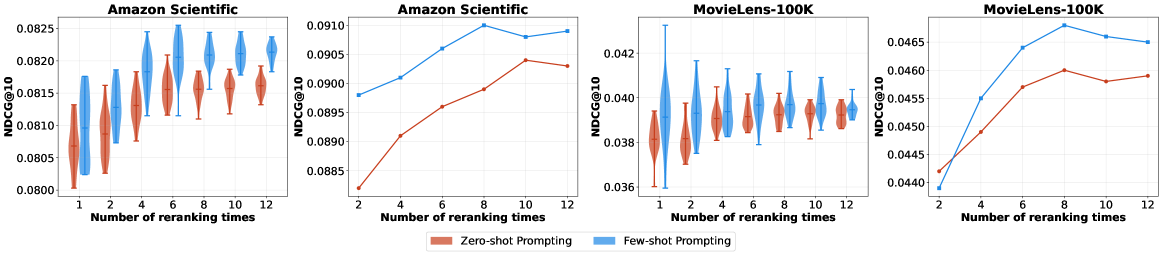
- Demonstrates robustness to noise, maintaining performance gains even as the number of voting rounds (N) increases, validating the theoretical concentration of measure guarantees
Breakthrough Assessment
7/10
A solid methodological improvement that addresses the specific instability of LLM generation in RS. The theoretical grounding via concentration of measure adds rigor, though the core components (LLM reranking + Contrastive Learning) are established techniques combined in a novel way.