📝 Paper Summary
LLM-enhanced Recommender Systems
Fairness in Recommender Systems
BiFair improves fairness in LLM-enhanced recommender systems by simultaneously optimizing the frozen LLM's item representations and the recommendation model's projector via a bi-level optimization framework.
Core Problem
LLM-enhanced recommender systems introduce two distinct sources of unfairness: 'prior unfairness' inherited from the LLM's pre-trained representations and 'training unfairness' arising from the recommendation model's training on biased interaction data.
Why it matters:
- Existing fairness methods address only one stage (pre-training, in-training, or post-training) and fail to coordinate the mitigation of both representation bias and training bias simultaneously
- Despite LLMs improving general recommendation quality, significant fairness gaps persist, where unpopular or minority item groups receive disproportionately low exposure
Concrete Example:
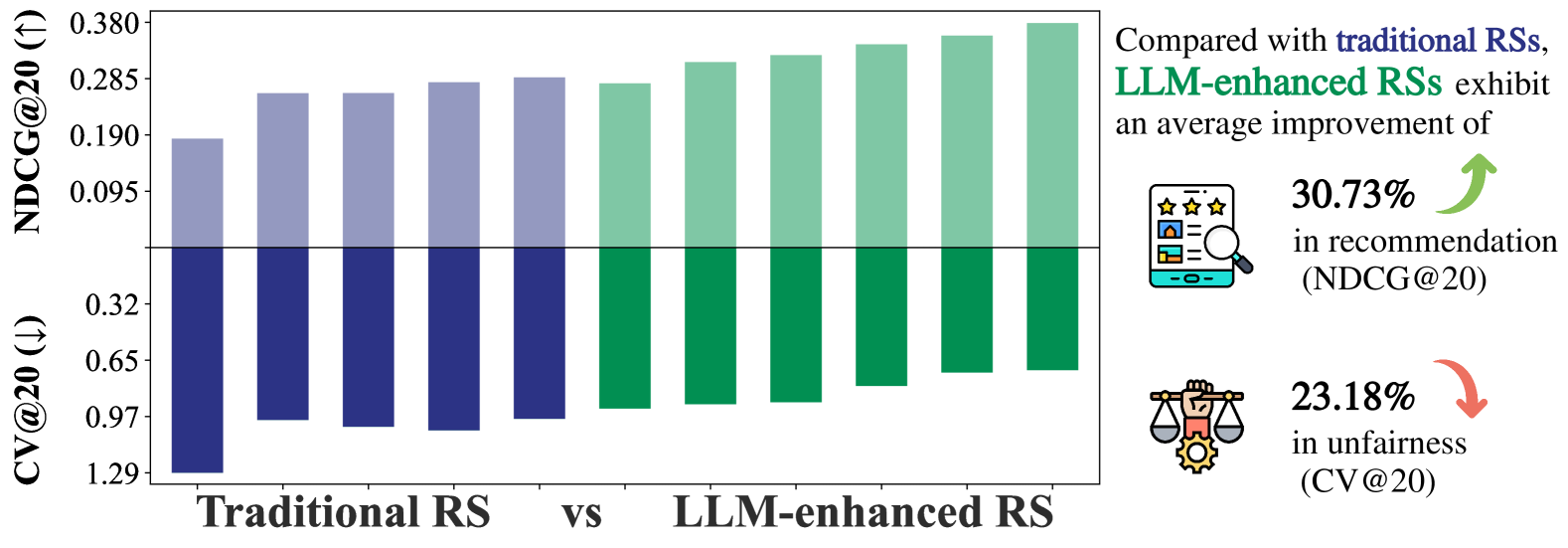
In an empirical study on the Amazon Book dataset, while LLM-enhanced models improved over traditional baselines, the worst-performing 25% of item groups still achieved only one-third of the average utility level.
Key Novelty
Bi-level Fairness Optimization (BiFair)
- Decomposes unfairness into prior unfairness (from LLM) and training unfairness (from RS), targeting both simultaneously
- Uses a bi-level optimization loop where the inner loop trains the recommendation projector and the outer loop refines the LLM-generated item representations based on the projector's feedback
- Introduces an adaptive inter-group balancing mechanism that dynamically adjusts loss weights to maximize the entropy of the loss distribution across groups
Architecture
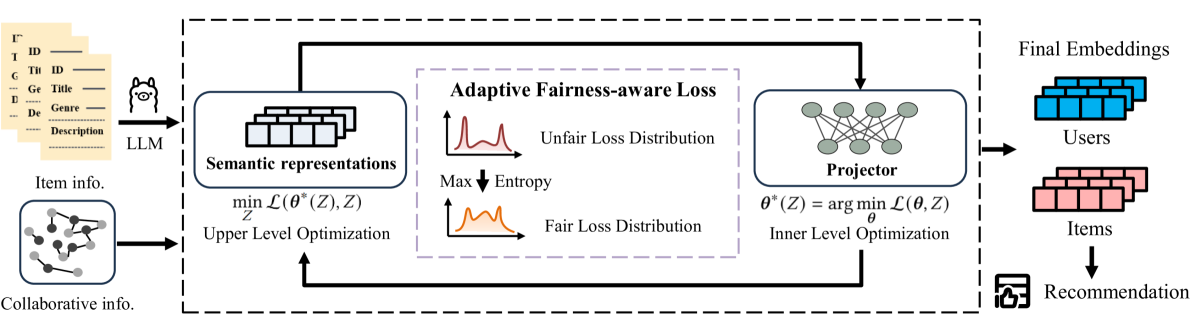
The BiFair framework's bi-level optimization process.
Evaluation Highlights
- Empirical study reveals that while LLM-enhanced systems generally improve fairness over ID-based methods, a severe gap remains where the bottom 25% of groups reach only ~33% of average utility
- Proposed method BiFair is claimed to significantly mitigate unfairness compared to state-of-the-art methods on three real-world datasets (specific numbers for BiFair not provided in text snippet)
Breakthrough Assessment
7/10
Novel decomposition of unfairness sources in the specific context of LLM-enhanced RS and a mathematically sound bi-level optimization approach. However, the provided text lacks the final quantitative results table for the proposed method.