📝 Paper Summary
User Simulation
Agentic Recommender Systems
DGDPO refines user simulator profiles by iteratively diagnosing defects using a specialized model and correcting them with a generalized model, enabling realistic multi-round evolution with sequential recommenders.
Core Problem
Existing LLM-based user simulators rely on static, single-step profiles that cannot correct initial inaccuracies or adapt to evolving interests, and fail to simulate realistic multi-round feedback loops.
Why it matters:
- Static profiles cause simulated behavior to progressively diverge from real user actions as errors persist uncorrected
- Current simulators mostly use single-round interactions with static recommenders, failing to capture how real users and systems mutually adapt over time
- General-purpose LLMs hallucinate when asked to self-diagnose profile defects, leading to unreliable updates
Concrete Example:
If an initial profile incorrectly states a user 'dislikes comedy' (Inaccurate), the simulator will consistently reject comedy recommendations. A standard LLM might fail to identify this contradiction from interaction history, whereas DGDPO diagnoses the specific defect and updates the profile.
Key Novelty
Diagnostic-Guided Dynamic Profile Optimization (DGDPO)
- Decouples the optimization into a 'Diagnostic' phase (identifying specific defects like inaccuracy or incompleteness) and a 'Treatment' phase (generating fixes)
- Uses a 'Specialized' small LLM for reliable diagnosis (trained on synthetic defects) and a 'Generalized' large LLM for complex reasoning and profile rewriting
- Integrates the simulator with Sequential Recommenders (SRs) to enable a bidirectional evolution where both the user profile and the recommender strategy update based on interaction history
Architecture
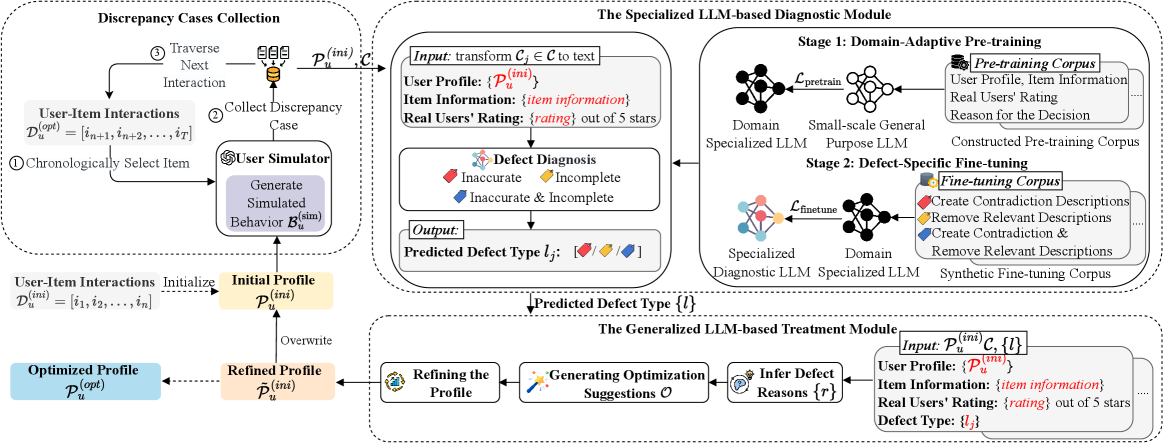
The DGDPO framework workflow involving the Diagnostic Module, Treatment Module, and interaction with Sequential Recommenders.
Evaluation Highlights
- Specialized diagnostic module achieves 92.20% average accuracy on profile defect identification
- General-purpose LLMs (without specialized training) achieve only 62.78% accuracy on the same defect identification task
- Demonstrates effective identification of 'Inaccurate', 'Incomplete', and combined profile defects compared to baselines
Breakthrough Assessment
7/10
Addresses a critical bottleneck in user simulation (static/hallucinated profiles) with a logical diagnostic-treatment split. The integration with Sequential Recommenders for bidirectional evolution is a significant step toward realistic simulation.