Persona4Rec shifts expensive LLM reasoning to an offline stage by generating multiple interpretable personas per item, enabling real-time recommendation via lightweight similarity scoring between user profiles and these pre-computed personas.
Core Problem
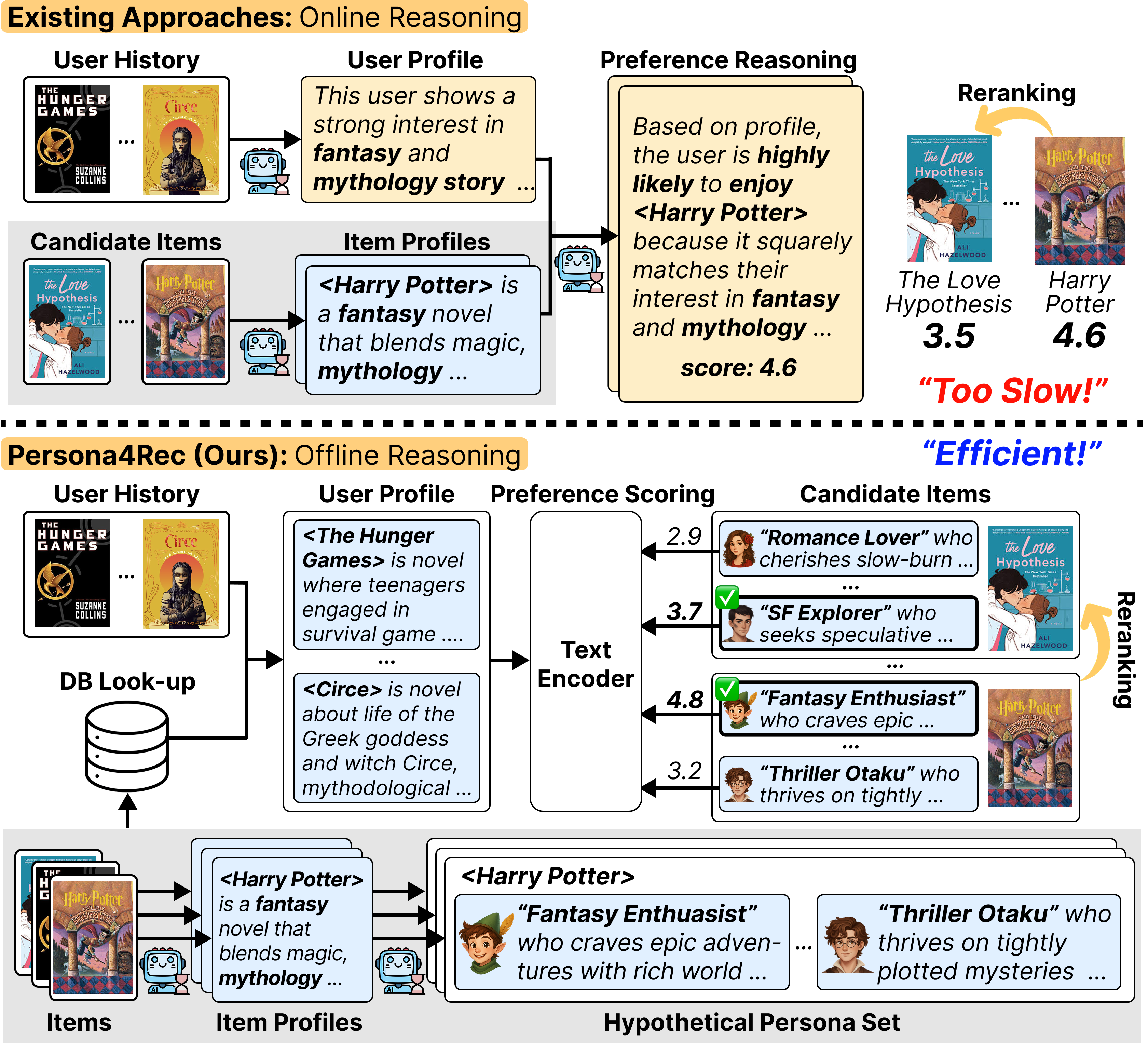
Current LLM-based recommender systems rely on expensive online reasoning to process user histories and item relevance, causing high latency that hampers real-world deployment.
Why it matters:
Real-time recommendation is essential for user experience, but LLM inference latency makes deployment impractical at scale.
Repeatedly inferring user profiles and reasoning over candidate items for every request is computationally wasteful.
Traditional collaborative filtering lacks the semantic depth to capture complex user motivations found in reviews.
Concrete Example:A system like LLM4Rerank must process a user's entire history and current candidate items through an LLM at inference time to determine relevance. Persona4Rec avoids this by matching a user's history against pre-generated 'Dark Storyline Seeker' personas offline, reducing the online step to a simple vector dot product.
Key Novelty
Offline Persona-Profiled Item Indexing
Decomposes items into multiple 'personas' (e.g., one item might have a 'gift buyer' persona and a 'quality seeker' persona) using LLMs offline, grounded in user reviews.
Trains a lightweight encoder to align user interaction histories with these specific item personas, replacing direct user-item matching with user-persona alignment.
Moves the 'reasoning' phase entirely offline, so online inference is just fast retrieval against a static index of personas.
Architecture
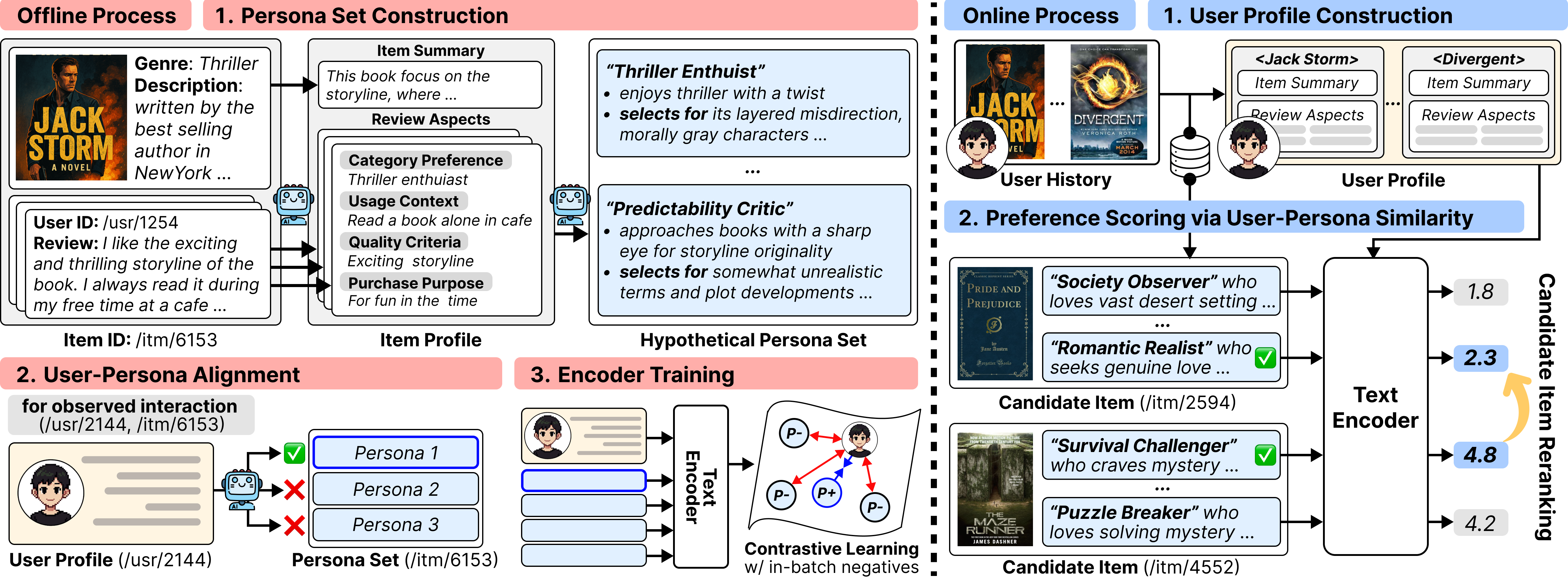
The two-stage framework of Persona4Rec: Offline Reasoning (Persona Construction, Alignment, Training) and Online Inference (User Profiling, Scoring).
Evaluation Highlights
Reduces inference time by up to 99.6% compared to state-of-the-art LLM-based rerankers (e.g., changing latency from ~200ms to ~1ms).
Achieves accuracy comparable to computationally expensive LLM rerankers like TALLRec and RLRF4Rec across multiple datasets.
Provides human-interpretable explanations for every recommendation by surfacing the specific 'persona' (e.g., 'Dark Storyline Seeker') that matched the user.
Breakthrough Assessment
8/10
Significantly addresses the critical latency bottleneck of LLM-based recommendation without sacrificing accuracy, while adding interpretability. A practical engineering solution to a theoretical problem.
โ๏ธ Technical Details
Problem Definition
Setting: Top-k Reranking Recommendation
Inputs: User interaction history H_u and a set of candidate items C_u generated by a base recommender.
Outputs: A reordered list of items based on relevance scores calculated via user-persona similarity.
Pipeline Flow
Offline: Item Summary & Aspect Extraction (LLM)
Offline: Persona Generation (LLM)
Offline: User-Persona Alignment (LLM-as-a-judge) -> Training Data
Offline: Encoder Training (Contrastive Learning)
Online: User Encoding -> Similarity Scoring against Persona Index
System Modules
Persona Generator (Offline Processing)
Converts item metadata and review aspects into K distinct textual personas.
Model or implementation: gpt-4o-mini
Alignment Judge (Offline Processing)
Selects the best matching persona for a user-item pair to create ground-truth training data.
Model or implementation: gpt-4o-mini
Dual Encoder
Embeds user profiles and personas into shared space for scoring.
Model or implementation: Lightweight Transformer-based encoder (implied, details not fully specified in snippet but distinct from LLM)
Novel Architectural Elements
Multi-persona indexing: Replacing single-vector item representations with a set of persona vectors derived from offline reasoning.
Review-grounded alignment loop: Using an LLM to explicitly align past user interactions to specific item personas to train a lightweight encoder.
Modeling
Base Model: gpt-4o-mini (for offline reasoning/data generation)
Training Method: Contrastive Learning (InfoNCE)
Objective Functions:
Purpose: Maximize similarity between a user and their aligned persona while minimizing similarity to negatives.
Formally: InfoNCE loss L = -log ( exp(sim(u, p+)/tau) / sum(exp(sim(u, p)/tau)) )
Adaptation: Not applicable (Training a separate lightweight encoder, not fine-tuning the LLM)
Trainable Parameters: Parameters of the lightweight user/persona encoder E_theta
Training Data:
Dataset D_align constructed by pairing users with the specific item persona that 'LLM-as-a-judge' deems most relevant to their history.
Key Hyperparameters:
K (personas per item): [2, 7]
gamma (temporal decay): (0, 1]
Compute: Inference time reduction up to 99.6% vs LLM rerankers. Training involves offline LLM calls (gpt-4o-mini).
Comparison to Prior Work
vs. TALLRec/RLRF4Rec: Persona4Rec moves reasoning offline, replacing online LLM inference with fast vector similarity.
vs. RLMRec: Persona4Rec explicitly models multiple 'personas' per item to capture diverse motivations, rather than a single enriched representation.
vs. P5 [not cited in paper]: P5 unifies recommendation tasks into a T5 model, but still requires transformer inference per user-item pair, whereas Persona4Rec pre-indexes item personas.
Limitations
Relies on the quality of the offline LLM (gpt-4o-mini) to generate accurate personas and alignments.
Static persona index might not capture real-time trends without periodic re-indexing.
Requires available reviews to generate rich subjective personas; relies on metadata summaries for cold-start items.
Code is publicly available at https://github.com/legenduck/PERSONA4REC. The paper uses gpt-4o-mini for all offline LLM tasks.
๐ Experiments & Results
Evaluation Setup
Top-k item reranking on standard recommendation datasets.
Benchmarks:
Specific datasets not named in snippet (Sequential Recommendation / Reranking)
Metrics:
Inference Time / Latency
Recommendation Accuracy (metrics implied but specific names like NDCG/HR not explicitly listed in snippet text, though 'performance comparable' is stated)
Statistical methodology: Not explicitly reported in the paper
Comparison of 'Online Reasoning' (traditional LLM reranking) vs 'Offline Reasoning' (Persona4Rec).
Main Takeaways
Achieves comparable accuracy to state-of-the-art LLM rerankers (TALLRec, etc.) while being orders of magnitude faster.
Persona representations enable interpretability by providing text rationales (e.g., 'Dark Storyline Seeker') for why an item was recommended.
Effective even in cold-start scenarios by falling back to metadata-based summaries when reviews are missing.
๐ Prerequisite Knowledge
Prerequisites
Collaborative Filtering (CF) basics
Large Language Models (LLMs) for text processing
Contrastive Learning (InfoNCE loss)
Dual-encoder architectures
Key Terms
Persona: A constructed profile representing a specific user motivation or latent segment (e.g., 'Budget Shopper') derived from item reviews and metadata.
Persona-profiled item index: A search index where items are represented not by a single vector, but by multiple vectors corresponding to their generated personas.
LLM-as-a-judge: Using an LLM to evaluate or label dataโin this case, determining which item persona best matches a user's past interaction to create training data.
InfoNCE: A contrastive loss function used to pull positive pairs (user and relevant persona) together and push negative pairs apart in embedding space.
Cold-start: A scenario where items have few or no interactions/reviews; Persona4Rec handles this by generating personas from metadata alone if needed.