📝 Paper Summary
Unified Search and Recommendation (S&R)
Parameter-Efficient Fine-Tuning (PEFT)
Multi-Task Learning in LLMs
GEMS unifies search and recommendation in LLMs by projecting gradients into shared and task-specific subspaces to resolve conflicts, while using null-space projection to preserve the model's pre-trained reasoning capabilities.
Core Problem
Applying Parameter-Efficient Fine-Tuning (PEFT) to unified Search & Recommendation causes gradient conflicts due to divergent objectives and degrades the LLM's general reasoning abilities (catastrophic forgetting).
Why it matters:
- Full fine-tuning of LLMs for S&R is computationally expensive and limits scalability.
- Search (short-term intent) and Recommendation (long-term preference) generate conflicting gradients, destabilizing training when forced into shared low-rank parameters.
- Overfitting to S&R data distorts the LLM's general-domain knowledge, causing it to fail at basic reasoning tasks it could previously handle.
Concrete Example:
In a standard PEFT setup, the search task might push gradients to prioritize query relevance, while recommendation pushes for user history alignment. These vectors may oppose each other (Figure 1a), canceling out progress. simultaneously, the model might lose the ability to answer general questions (Figure 1b) due to representation shift.
Key Novelty
Gradient Multi-Subspace Tuning (GEMS)
- Decomposes optimization into three low-rank subspaces: a 'shared' subspace for common signals, and two 'task-specific' subspaces for Search and Recommendation, preventing destructive interference.
- Identifies the 'principal' directions of the pre-trained model's knowledge using SVD and projects all updates onto the 'null space' (orthogonal directions), ensuring new learning doesn't overwrite existing general knowledge.
Architecture
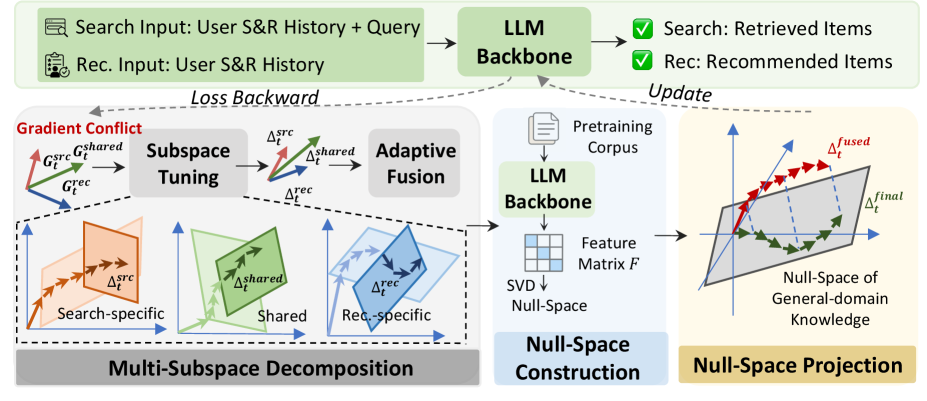
Schematic of the GEMS framework illustrating the Multi-Subspace Decomposition and Null-Space Projection processes during an optimization step.
Breakthrough Assessment
8/10
Proposes a mathematically grounded approach (subspace tuning) to solve the specific multi-task interference problem in LLMs without adding inference parameters, addressing both stability and forgetting.