📝 Paper Summary
Recommender Systems
Cold-Start Recommendation
M-LLM3REC addresses cold-start recommendation by using LLMs to extract deep motivational intents from sparse user interactions and aligning them with abstract product traits, rather than relying on interaction frequency.
Core Problem
Traditional recommenders struggle with cold-start and sparse-data scenarios because they rely on dense interaction history, while current LLM approaches often focus on superficial semantic similarity rather than underlying user motivation.
Why it matters:
- Sparse data and cold-start users are pervasive in real-world platforms, leading to poor user experience.
- Existing generative augmentation methods (e.g., diffusion) introduce noise, while semantic methods often fail to capture dynamic shifts in user intent.
- Relying solely on historical behavior ignores that different users may buy the same item for vastly different reasons (e.g., aesthetics vs. functionality).
Concrete Example:
A user with only two interactions might buy a backpack. A traditional model sees 'backpack' and recommends more bags. M-LLM3REC infers the user's motivation is 'sustainable travel' based on the product description and reviews, recommending eco-friendly travel gear instead of just more backpacks.
Key Novelty
Motivation-Driven Semantic Alignment
- Shifts the recommendation anchor from 'behavioral patterns' (who bought what) to 'motivational intent' (why they bought it).
- Uses LLMs to distill sparse interactions into structured motivational profiles (e.g., functionality, aesthetics) and items into abstract traits.
- Performs recommendation via a direct compatibility check between the user's inferred motivation and the item's distilled traits.
Architecture
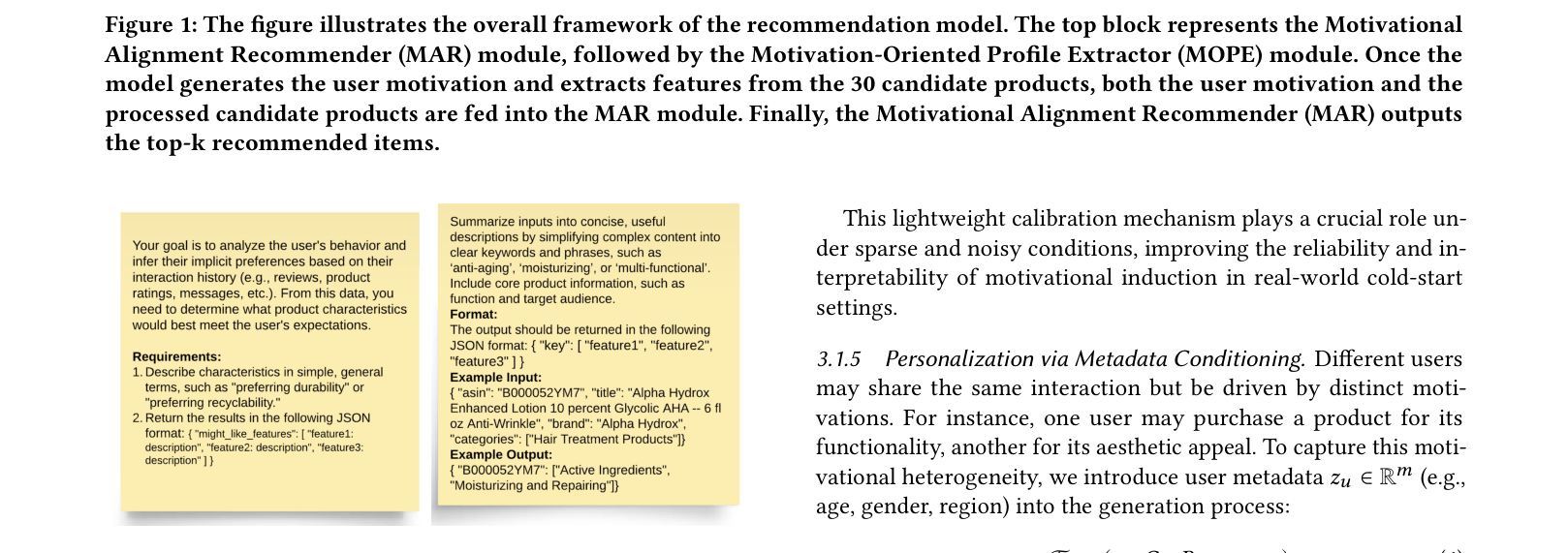
The overall 3-stage pipeline of M-LLM3REC: Profiling, Encoding, and Alignment.
Evaluation Highlights
- Achieves 0.709 HR@10 on Beauty dataset, outperforming sequential baseline SASRec (0.4604) by ~54%.
- In extreme cold-start (users with <3 interactions), outperforms traditional baselines (BPR, LightFM) by nearly an order of magnitude on Toys dataset (0.456 vs 0.1258 HR@5).
- Outperforms state-of-the-art LLM-based method A-LLMRec on Toys dataset (0.684 vs 0.436 HR@10) and Sports dataset.
Breakthrough Assessment
7/10
Strong performance in cold-start settings by redefining the problem as motivation matching. The modular LLM pipeline is intuitive, though the computational cost of LLM inference per user/item pair is a practical constraint.