📝 Paper Summary
User modeling
Conversational personalization
A neuro-symbolic framework mitigates filter bubbles in recommender systems by selectively restructuring the user's Personalized Knowledge Graph at inference time to suppress over-reinforced feature associations without model retraining.
Core Problem
Over-personalization in recommender systems leads to Personalized Information Environments (PIEs), where algorithms reinforce existing biases and narrow content exposure (filter bubbles).
Why it matters:
- Users become trapped in content silos that reduce discovery and agency, repeatedly seeing similar items based on past interactions
- Existing solutions often require expensive retraining of large models or rely on opaque embeddings that lack interpretability and user control
- Without explicit mechanisms to break these cycles, users struggle to diversify their recommendations even when they desire novelty
Concrete Example:
A user who frequently rates tomato-based Italian dishes highly creates a strong 'Italian + Tomato' bias. When asking for a new Italian dish, standard systems recommend more 'Tomato Pasta' or 'Lasagna' (In-PIE), whereas the user might prefer 'Pesto Pasta' (Out-PIE)—relevant to Italian cuisine but breaking the tomato dominance.
Key Novelty
Rule-Guided Knowledge Graph Adaptation
- Treat the user's profile as a structured Personalized Knowledge Graph (PKG) that can be symbolically edited at inference time
- Detect specific 'PIE-inducing' feature pairs (e.g., Italian + Tomato) where user preference is statistically over-amplified
- Apply symbolic rules (Soft, Hard, or Removal) to down-weight these specific edges in the graph before passing it to the LLM, steering generation toward diverse but relevant items
Architecture
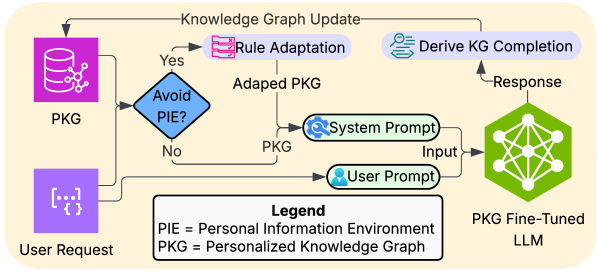
Overview of the recommendation pipeline: PIE detection, PKG Adaptation, and LLM Inference.
Evaluation Highlights
- Soft adaptation increases Out-PIE (novel, relevant) recommendations from 25.2% to 32.4% compared to a global adaptation baseline
- Reduces Invalid recommendations (irrelevant content) from 49.0% to 46.0% while breaking filter bubbles, unlike prompt-based methods which degrade relevance
- Prompt-based natural language instructions fail to avoid PIEs effectively, yielding only 19.3% Out-PIE results and a high 62.1% Invalid rate
Breakthrough Assessment
7/10
Offers a lightweight, interpretable alternative to retraining for filter bubble mitigation. While the absolute gains are moderate, the symbolic inference-time control is a valuable architectural shift.