📝 Paper Summary
Recommender Systems
Electric Vehicle (EV) Infrastructure
LLM Applications
RecomBot combines LLaMA-3-8B with RAG and constraint optimization to provide personalized, context-aware electric vehicle charging station recommendations from natural language queries.
Core Problem
EV charging infrastructure growth is insufficient, and existing recommendation systems struggle with fragmented real-time data and fixed constraints, leading to range anxiety and long wait times.
Why it matters:
- Inadequate management of charging stations (CSs) leads to dissatisfaction and reduced trust in EV technology, potentially slowing adoption
- Current recommenders often lack the flexibility to integrate heterogeneous data sources (weather, grid load, user preferences) into a unified reasoning framework
- Drivers in high-traffic areas or adverse weather need dynamic, context-aware suggestions rather than static lists
Concrete Example:
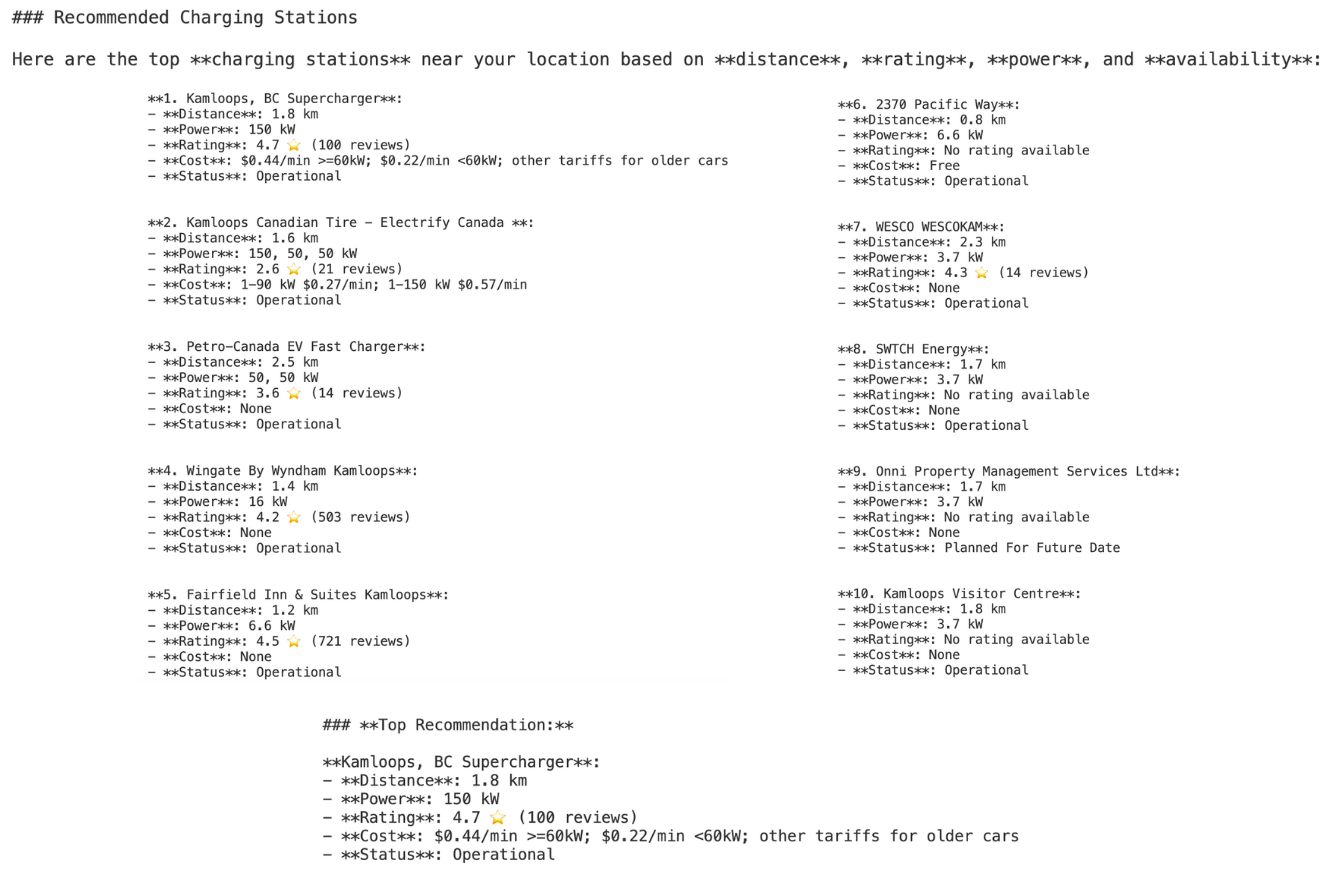
A user asks for 'fast charging high rated' stations. A standard system might return a close but low-rated station. RecomBot identifies 'Kamloops, BC Supercharger' (150 kW, 4.7 rating) as the optimal match over a closer but lower-rated alternative.
Key Novelty
RecomBot (LLM-powered RAG + Optimization)
- Integrates Large Language Models (LLMs) with formal constraint optimization to balance user preferences (price, distance) against hard constraints
- Employes a Retrieval-Augmented Generation (RAG) framework to fetch real-time data from external APIs (Open Charge Map, Google Cloud) before reasoning
- Utilizes a reinforcement learning feedback loop to dynamically adjust preference weights based on user interactions
Architecture
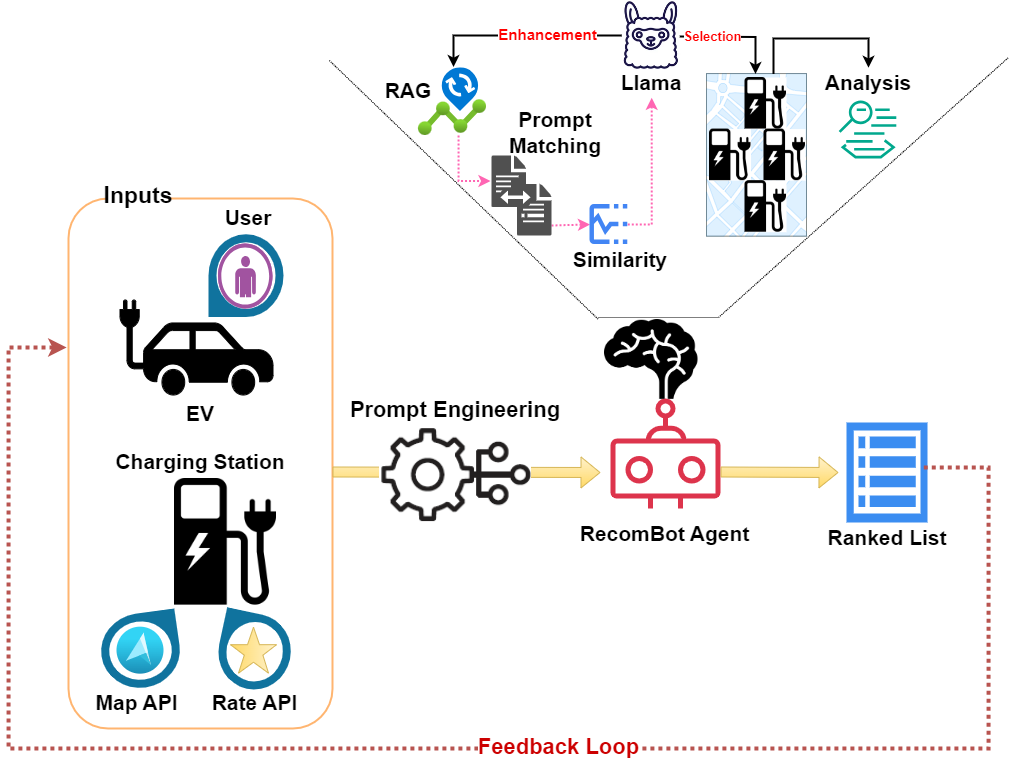
The general architecture of RecomBot, detailing the flow from user query to final recommendation.
Evaluation Highlights
- Successfully retrieved and ranked high-power stations (150 kW) in a case study in Kamloops, Canada
- Correctly prioritized 'Kamloops, BC Supercharger' (Rating 4.7) over 'Canadian Tire-Electrify Canada' (Rating 2.6) for quality-focused queries
- Demonstrated dynamic ranking adaptation: prioritizing distance for 'near me' queries vs. price/rating for 'cheap high-rated' queries
Breakthrough Assessment
3/10
Applies existing techniques (LLM, RAG, Optimization) to a specific domain (EVs). Evaluation is limited to a single case study without quantitative performance metrics (precision/recall) or baseline comparisons.