📝 Paper Summary
Sequential Recommendation
Generative Recommendation
LLMDiRec integrates semantic knowledge from Large Language Models into an intent-aware diffusion framework to generate meaningful, intent-consistent training samples for sequential recommendation, improving performance on sparse and long-tail items.
Core Problem
Existing sequential recommenders rely on ID-based embeddings that lack semantic meaning, causing them to misinterpret user intent (e.g., grouping unrelated items by co-occurrence) and fail on cold-start or long-tail items where interaction data is sparse.
Why it matters:
- ID-based models suffer from 'semantic blindness,' often grouping items like a mouse and a textbook solely because they were bought together, missing the distinct underlying intents (e.g., 'school supplies' vs 'gaming').
- Long-tail items and cold-start users have few interactions, making collaborative signals weak; without semantic grounding, models cannot effectively recommend these items, reinforcing popularity bias.
Concrete Example:
A user buys a 'gaming mouse' and a 'textbook.' A standard ID-based model might cluster the sequence under 'electronics' due to the mouse, ignoring the 'school supplies' intent of the textbook. LLMDiRec uses LLM descriptions to recognize that a uniform and an iPad, while collaboratively unrelated, share a 'for school' semantic intent.
Key Novelty
Dual-View Intent-Aware Diffusion
- Represents items using two views: a collaborative ID embedding (interaction patterns) and a frozen LLM-derived semantic embedding (content knowledge), fused via a learned gating mechanism.
- Conditions the diffusion process (used for data augmentation) on semantic intent prototypes derived from clustering these dual-view representations, ensuring generated sequences are semantically coherent rather than just statistically probable.
Architecture
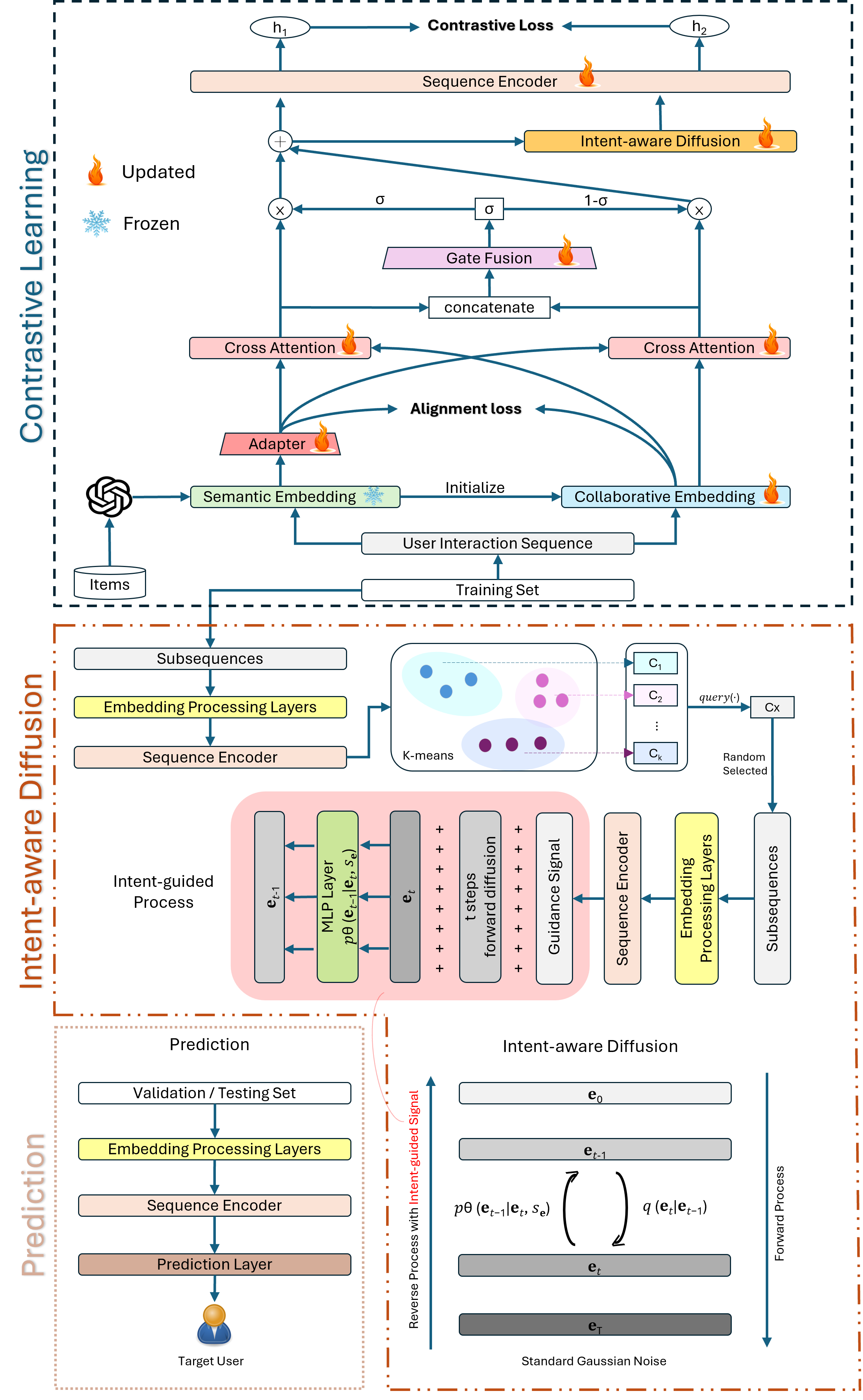
The LLMDiRec framework illustrating the three main phases: Dual-View Item Representation, Intent-Aware Diffusion, and Multi-Task Optimization.
Evaluation Highlights
- Outperforms state-of-the-art InDiRec by 5–8% in HR@10 and NDCG@10 on sparse datasets (Sports, Toys, Yelp).
- Achieves massive gains for long-tail items (bottom 20% popularity): +160% HR@10 on MovieLens-1M and +113% on Amazon Toys compared to baselines.
- Improves cold-start user performance by ~10% on Amazon Toys and Sports datasets relative to InDiRec.
Breakthrough Assessment
8/10
Strong methodological contribution by effectively fusing LLM semantics into the diffusion generation process (not just as features), yielding significant gains on the persistent long-tail/cold-start problem.