Yijun Pan, Weikang Qiu, Qiyao Ma, Mingxuan Ju, Tong Zhao, Neil Shah, Rex Ying
arXiv
(2026)
RecommendationRLP13N
📝 Paper Summary
LLM-based RecommendationReinforcement Learning from Verifiable Rewards (RLVR)
FlexRec aligns LLMs to dynamic recommendation needs using a swap-based item-level reward for fine-grained credit assignment and an uncertainty-aware critic to stabilize training under sparse feedback.
Core Problem
Traditional recommenders optimize static objectives (e.g., clicks) and struggle to adapt to dynamic needs, while applying RL to LLM recommenders fails due to coarse list-level rewards and instability from sparse, noisy feedback.
Why it matters:
Real-world user intents shift rapidly (e.g., from 'buying' to 'exploring'), but models trained on single objectives cannot adapt without retraining
Sequence-level rewards in standard RL (like GRPO) assign the same credit to every item in a list, failing to distinguish between good and bad placements
Reliance on noisy reward predictors in sparse data settings causes high-variance gradient updates, destabilizing LLM alignment
Concrete Example:A user might want 'trending items' today but 'niche discoveries' tomorrow. A standard model, or an LLM trained with simple list-level RL, might treat a list as 'good' overall even if specific items fail the current 'niche' constraint, unable to learn exactly which item placement was the error.
Key Novelty
Counterfactual Swap-based RL with Uncertainty Scaling
Calculates the specific contribution of an item by virtually swapping it with other candidates in the list and measuring the change in the ranking metric (e.g., NDCG), providing dense, item-specific supervision
Integrates a critic that predicts both reward value and uncertainty (variance); the optimization step scales down updates when uncertainty is high, preventing the model from learning from unreliable, sparse feedback signals
Architecture
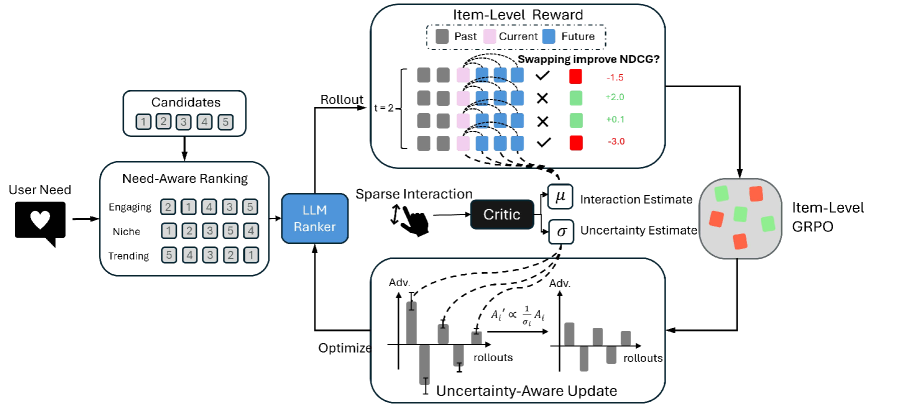
The FlexRec post-training framework illustrating the flow from list generation to reward calculation and policy update.
Evaluation Highlights
Improves NDCG@5 by up to 59% in need-specific ranking tasks compared to baselines
Achieves up to 109.4% improvement in Recall@5 for specific user needs
Demonstrates generalization capability with up to 24.1% Recall@5 improvement on unseen needs
Breakthrough Assessment
8/10
Addresses two fundamental bottlenecks in applying RL to recommendation (credit assignment and sparsity) with theoretically grounded solutions (counterfactual swaps and uncertainty weighting), yielding very large reported gains.
⚙️ Technical Details
Problem Definition
Setting: Closed-set autoregressive ranking conditioned on user context and explicit need instructions
Inputs: Context x = (User history U, Candidate set C, Need instruction n)
Outputs: Ordered permutation y of the candidate set C
Pipeline Flow
Group Generation: Sample multiple rankings for a context
Evaluation: Calculate Item-Level Rewards via Swaps + Sequence Rewards for formatting
Critic Assessment: Estimate Reward Uncertainty
Optimization: GRPO Update weighted by uncertainty
System Modules
LLM Policy
Generates the autoregressive ranking sequence conditioned on context and need
Model or implementation: LLM (architecture not specified in snippet)
Uncertainty-Aware Critic (Evaluation)
Predicts reward values and their variance (uncertainty) to identify unreliable feedback
Model or implementation: Neural Network (trained to predict reward means and variances)
Swap-based Reward Engine (Evaluation)
Computes marginal contribution of items via counterfactual swaps
Model or implementation: Deterministic Algorithm
Novel Architectural Elements
Hybrid reward assignment: Item-level swap rewards for item tokens vs. sequence-level rewards for reasoning/formatting tokens
Integration of uncertainty (variance) estimation directly into the GRPO advantage scaling
Modeling
Base Model: LLM (specific base model name not reported in snippet)
Training Method: FlexRec (Uncertainty-aware GRPO with Swap Rewards)
Objective Functions:
Purpose: Calculate fine-grained credit for item selection.
Formally: r_k^CS = Expectation over swaps of [NDCG(original) - NDCG(swapped)]
Purpose: Down-weight updates from unreliable/sparse rewards.
Statistical methodology: Not explicitly reported in the paper
Main Takeaways
FlexRec significantly outperforms baselines in need-specific ranking (up to +59% NDCG@5), validating the efficacy of fine-grained item-level rewards.
The uncertainty-aware update mechanism allows the model to learn effectively even with sparse/noisy reward signals, achieving over 100% gains in Recall@5 in some settings.
The approach generalizes well to unseen needs (+24.1% Recall@5), suggesting the model learns robust ranking strategies rather than just overfitting to training objectives.
Jointly training on multiple needs produces a 'universal recommender' that remains competitive across all scenarios without needing separate models.
📚 Prerequisite Knowledge
Prerequisites
Reinforcement Learning from Verifiable Rewards (RLVR)
Group Relative Policy Optimization (GRPO)
Autoregressive Sequence Generation
Ranking Metrics (NDCG)
Key Terms
GRPO: Group Relative Policy Optimization—an RL algorithm that normalizes rewards within a group of outputs generated from the same prompt to reduce variance without a separate value network
NDCG: Normalized Discounted Cumulative Gain—a measure of ranking quality that accounts for the position of relevant items, giving higher scores to hits at the top of the list
counterfactual swap: A method of estimating an item's value by calculating how the total score would change if that item were swapped with another item lower in the list
autoregressive ranking: Generating a ranked list one item at a time, where the choice of the next item depends on the items already selected
critic: A neural network module in RL that estimates the expected reward (value) of a state or action to guide the policy update
RLVR: Reinforcement Learning from Verifiable Rewards—an alignment technique where the model is trained using objective, programmatic rewards (like correct math answers or valid code) rather than human preference labels