📝 Paper Summary
Session-based Recommendation (SBR)
Graph Neural Networks (GNNs)
Large Language Models (LLMs) in Recommendation
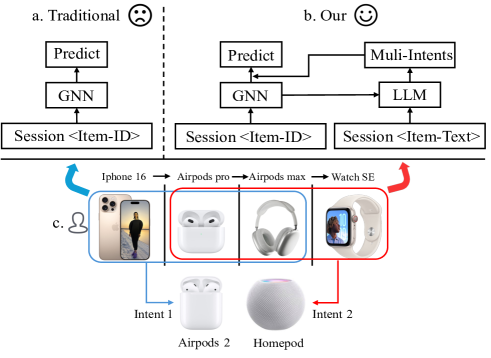
LLM-DMsRec integrates LLM-inferred multi-faceted user intents (explicit and latent) with GNN-based structural patterns using a candidate item set to ground the LLM's reasoning.
Core Problem
Existing GNN-based methods for session recommendation rely heavily on ID sequences, ignoring rich semantic information, while direct LLM applications often suffer from hallucinations and fail to align semantic insights with structural graph data.
Why it matters:
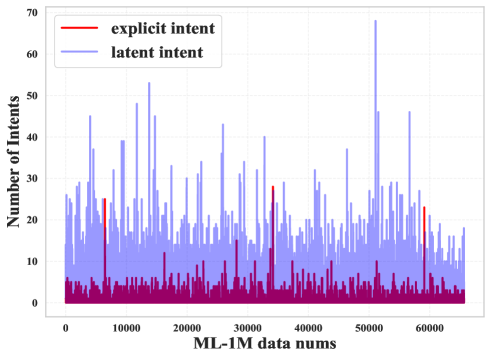
- Users in session-based systems often have dynamic, multi-faceted intentions (e.g., browsing both phones and headphones) that single-vector ID embeddings fail to capture
- Pure LLM approaches lack the collaborative signal found in interaction graphs, leading to plausible but incorrect recommendations (hallucinations)
- Bridging the gap between semantic understanding (text) and structural patterns (IDs) is critical for accurate next-item prediction
Concrete Example:
A user clicks 'iPhone 16' -> 'Airpods Pro' -> 'Airpods Max' -> 'Watch SE'. A traditional model sees only IDs. An LLM can infer two distinct intents: 'purchase headphones' (first three items) and 'acquire phone-connected device' (last three). LLM-DMsRec explicitly models both to refine the next prediction.
Key Novelty
Integrating LLM-Derived Multi-Semantic Intent into Graph Model (LLM-DMsRec)
- Uses a pre-trained GNN to generate a candidate item set, acting as a 'knowledge base' to constrain and ground the LLM's reasoning, reducing hallucinations
- Prompts the LLM to infer multiple semantic intents (explicit vs. latent) from the session text and candidate items, rather than a single summary
- Aligns these semantic intent representations with the GNN's structural representations using a KL divergence strategy during training
Architecture
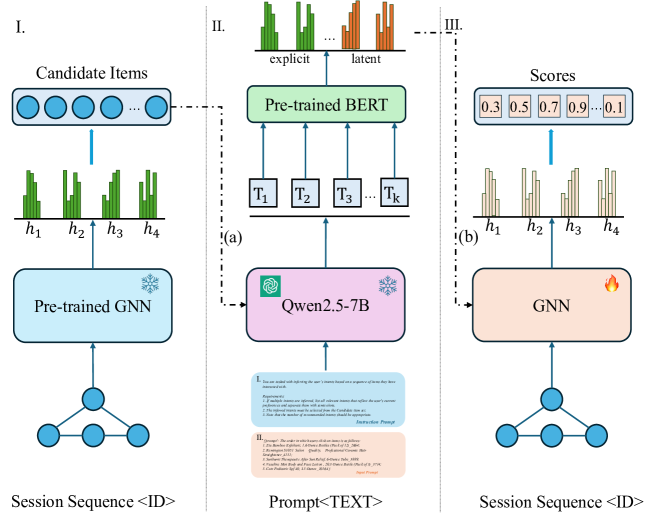
The overall architecture of LLM-DMsRec, illustrating the three stages: Candidate Item Selection, Intent Inference, and Alignment/Training.
Evaluation Highlights
- Outperforms state-of-the-art baselines on Beauty dataset: +7.24% improvement in MRR@20 compared to the best baseline (GCE-GNN)
- Achieves superior performance on ML-1M dataset: +2.90% improvement in P@20 over the strongest baseline
- Successfully integrates with multiple GNN backbones (SR-GNN, GCE-GNN, DHCN), consistently improving their performance
Breakthrough Assessment
7/10
Solid contribution in aligning LLM semantic reasoning with GNN structural signals. The method of using GNN candidates to ground LLM reasoning is a practical solution to hallucinations in recommendation.