📝 Paper Summary
LLM-based Recommendation
Graph Signal Processing for Recommendation
FreLLM4Rec identifies that LLMs systematically strip away essential low-frequency collaborative signals layer-by-layer and introduces graph-based frequency filters to preserve this information for better recommendation.
Core Problem
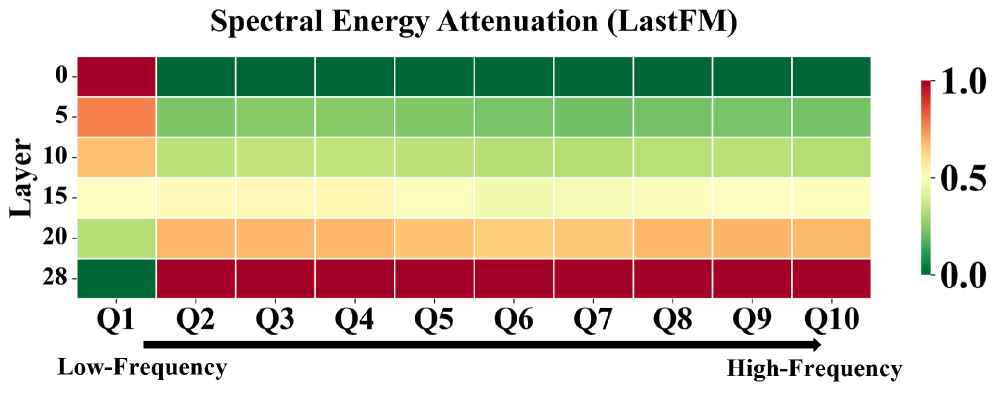
LLM-based recommenders effectively capture semantic information but suffer from 'Intra-Layer Spectral Attenuation,' where the model's internal reasoning mechanisms progressively weaken the collaborative signals (user interaction patterns) encoded in the input.
Why it matters:
- Semantic understanding alone cannot capture the collaborative patterns (co-occurrence) essential for effective recommendation
- Simply feeding pre-trained collaborative embeddings into an LLM fails because the LLM architecture actively attenuates the low-frequency components that carry this information
- Current methods treat LLMs as black boxes without addressing how the internal architecture degrades collaborative signal integrity
Concrete Example:
In a standard Transformer-based recommender like SASRec, low-frequency (collaborative) energy is preserved or enhanced across layers. In contrast, when an LLM processes the same sequence, spectral analysis reveals that the energy of these vital low-frequency components monotonically decreases deep in the network, replaced by high-frequency noise.
Key Novelty
FreLLM4Rec (Frequency-aware LLM for Recommendation)
- Identifies 'Intra-Layer Spectral Attenuation' via rigorous spectral analysis, showing LLMs act as high-pass filters that erode collaborative info
- Applies a Global Graph Low-Pass Filter (G-LPF) to purify item embeddings before they enter the LLM
- Uses Temporal Frequency Modulation (TFM) within the model to actively preserve collaborative signals by filtering out high-frequency noise in the frequency domain
Architecture
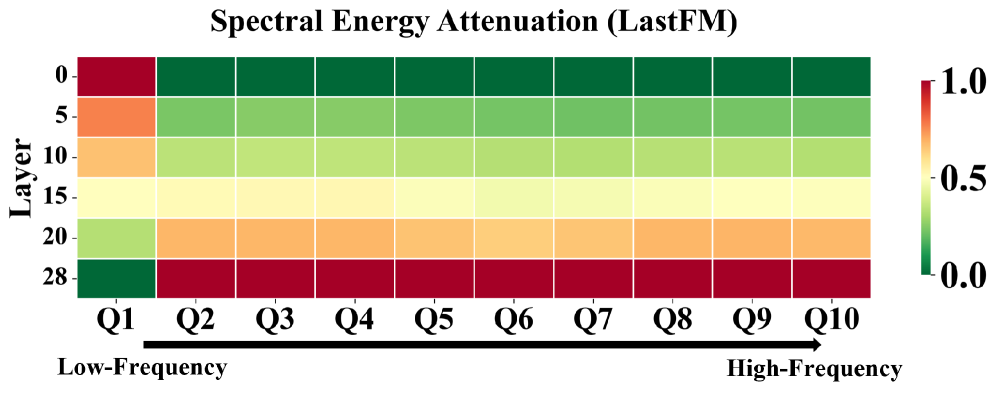
The complete architecture of FreLLM4Rec, showing the integration of frequency-aware modules.
Evaluation Highlights
- Achieves improvements of up to 8.00% in NDCG@10 over the best baseline across four benchmark datasets
- Spectral analysis confirms that standard LLMs attenuate low-frequency energy (collaborative signals) while SASRec preserves it, validating the theoretical premise
- Demonstrates that frequency-domain filtering can theoretically substitute for computationally expensive local graph filters
Breakthrough Assessment
7/10
Strong theoretical contribution by diagnosing the 'spectral attenuation' failure mode in LLMs. The solution is mathematically grounded in Graph Signal Processing. However, the result magnitude is incremental (up to 8%) rather than transformative.