📝 Paper Summary
Federated Sequential Recommendation
LLM-augmented Recommendation
Contrastive Learning
LUMOS addresses data scarcity in federated sequential recommendation by using on-device LLMs to generate synthetic future, paraphrased, and counterfactual user behaviors for private contrastive learning.
Core Problem
Federated sequential recommendation (FedSeqRec) suffers from sparse, short interaction histories on individual client devices, making it hard to learn stable user representations without centralizing data.
Why it matters:
- Standard federated learning (FL) fails on cold-start or infrequent users because local data is too scarce to train powerful sequence encoders like SASRec
- Traditional data augmentations (masking, cropping) designed for large centralized datasets often destroy semantic structure when applied to short local sequences
- Existing contrastive FL methods often compromise privacy by sharing embeddings or gradients, or require heavy server-side coordination
Concrete Example:
A user might have only 5 interactions (e.g., buying a phone case). A standard federated model sees just this short sequence. LUMOS uses an LLM to hallucinate that the user *might* next buy a screen protector (future view) or rephrases the history as 'purchased mobile accessories' (paraphrased view), providing richer signals for training.
Key Novelty
LUMOS: Local LLM-driven Multi-view Optimization for Sequential recommendation
- Treats the local LLM as a privacy-preserving 'behavioral generator' that creates synthetic data (plausible futures, paraphrased histories, and hard negatives) directly on the client device
- Integrates these synthetic sequences into a tri-view contrastive learning objective that forces the recommendation model to align real user history with plausible variations while pushing away inconsistent behaviors
Architecture
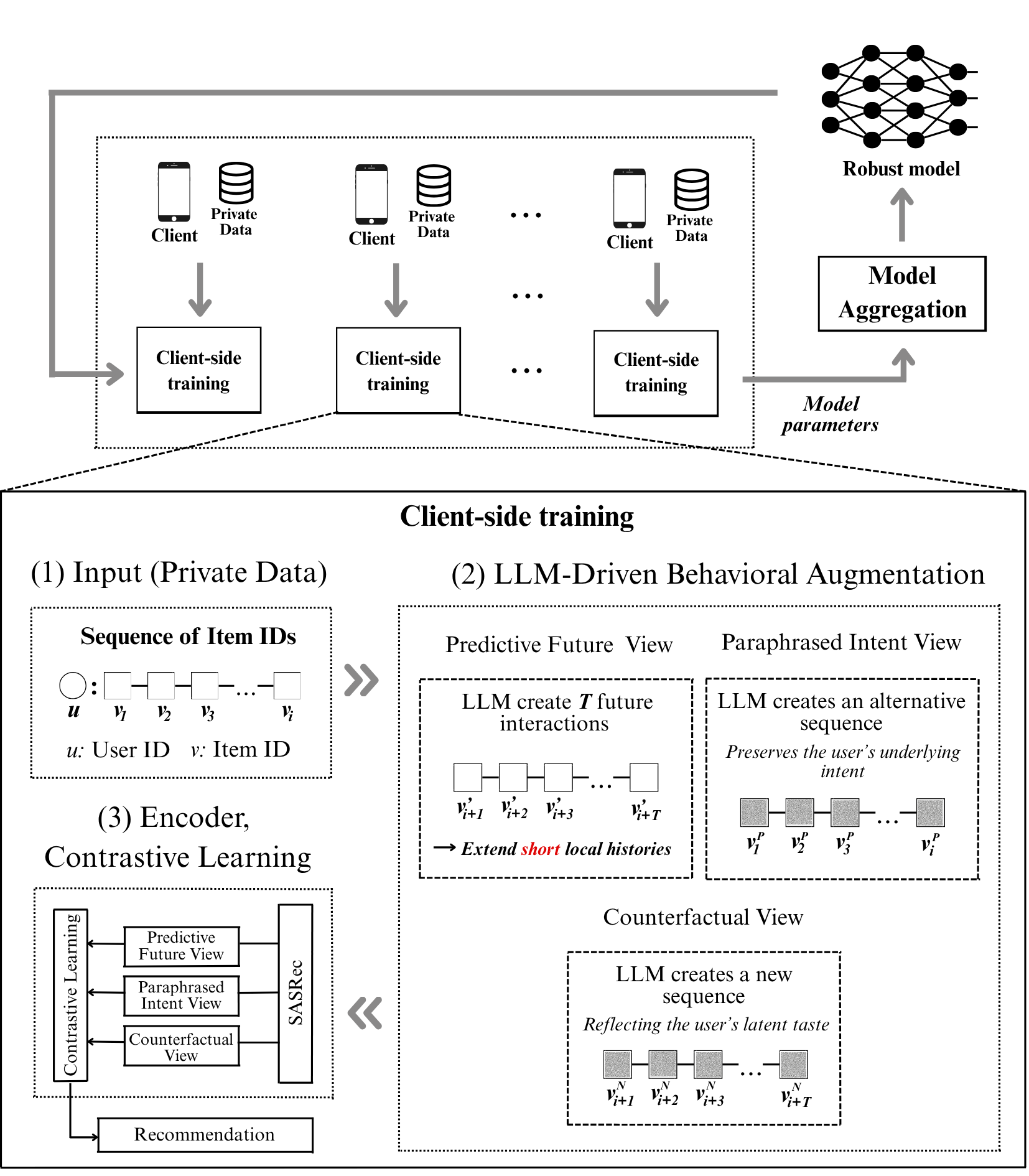
The LUMOS framework illustrating the client-side workflow: LLM generation of three views (Future, Paraphrase, Counterfactual) from the raw sequence, followed by shared encoding and tri-view contrastive optimization.
Evaluation Highlights
- Outperforms state-of-the-art federated baseline ConFedSRS(SASRec) by 6.2–7.6% HR@20 across Amazon and MIND datasets
- Surpasses centralized SASRec training on all datasets, demonstrating that LLM-augmented local training can beat centralized training on raw data
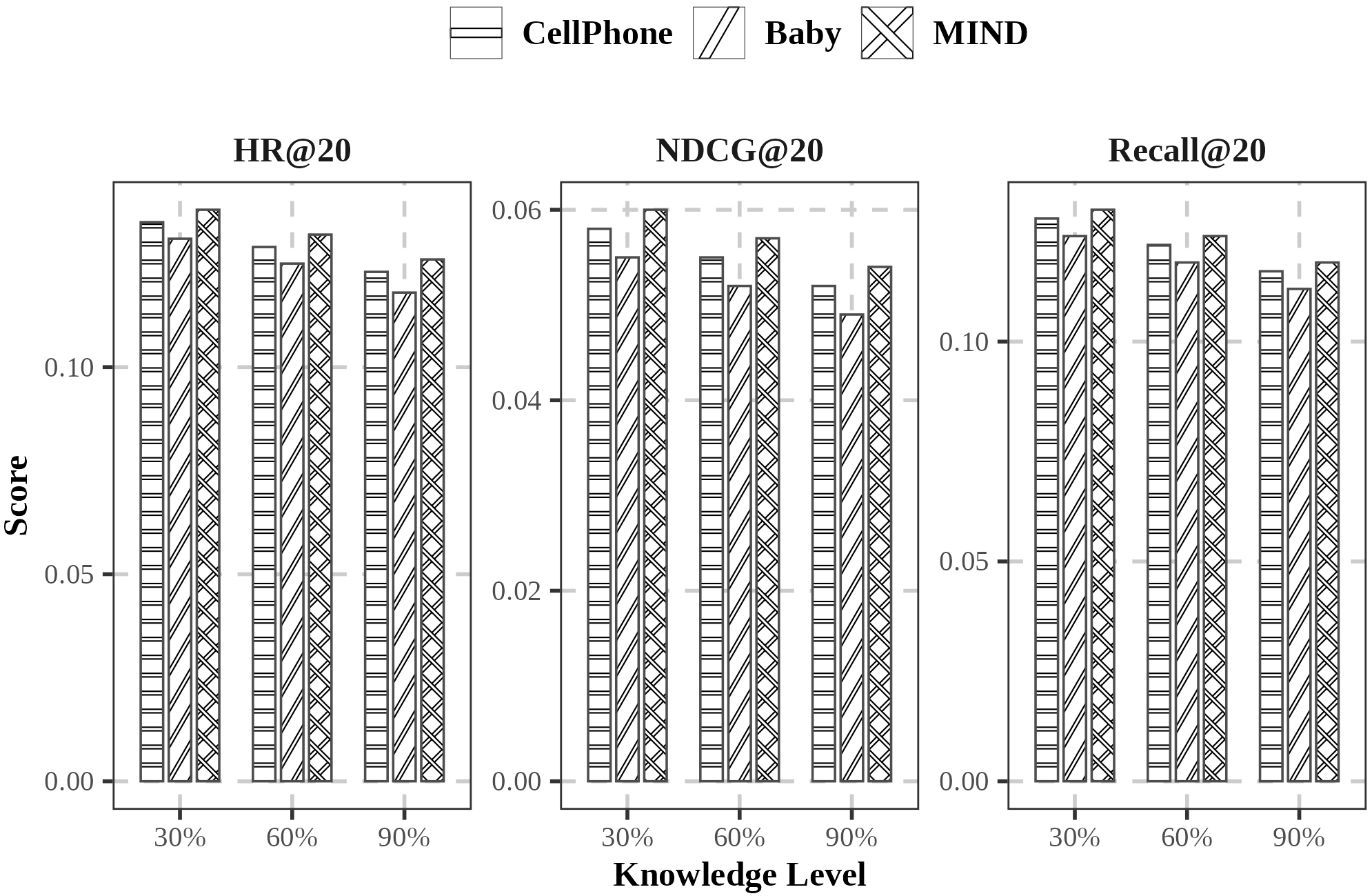
- Maintains robustness against adversarial noise, with only ~0.01 drop in HR@20 even when 90% of knowledge is exposed to attackers
Breakthrough Assessment
8/10
Significantly improves federated recommendation by effectively utilizing client-side LLMs for data augmentation, surpassing even centralized baselines. A strong practical contribution to privacy-preserving AI.