📝 Paper Summary
Job Recommendation
Generative Adversarial Networks (GANs)
User Profiling with LLMs
LGIR improves job recommendations by using LLMs to infer skills from user interaction history and a GAN to refine the quality of resume embeddings for users with scarce data.
Core Problem
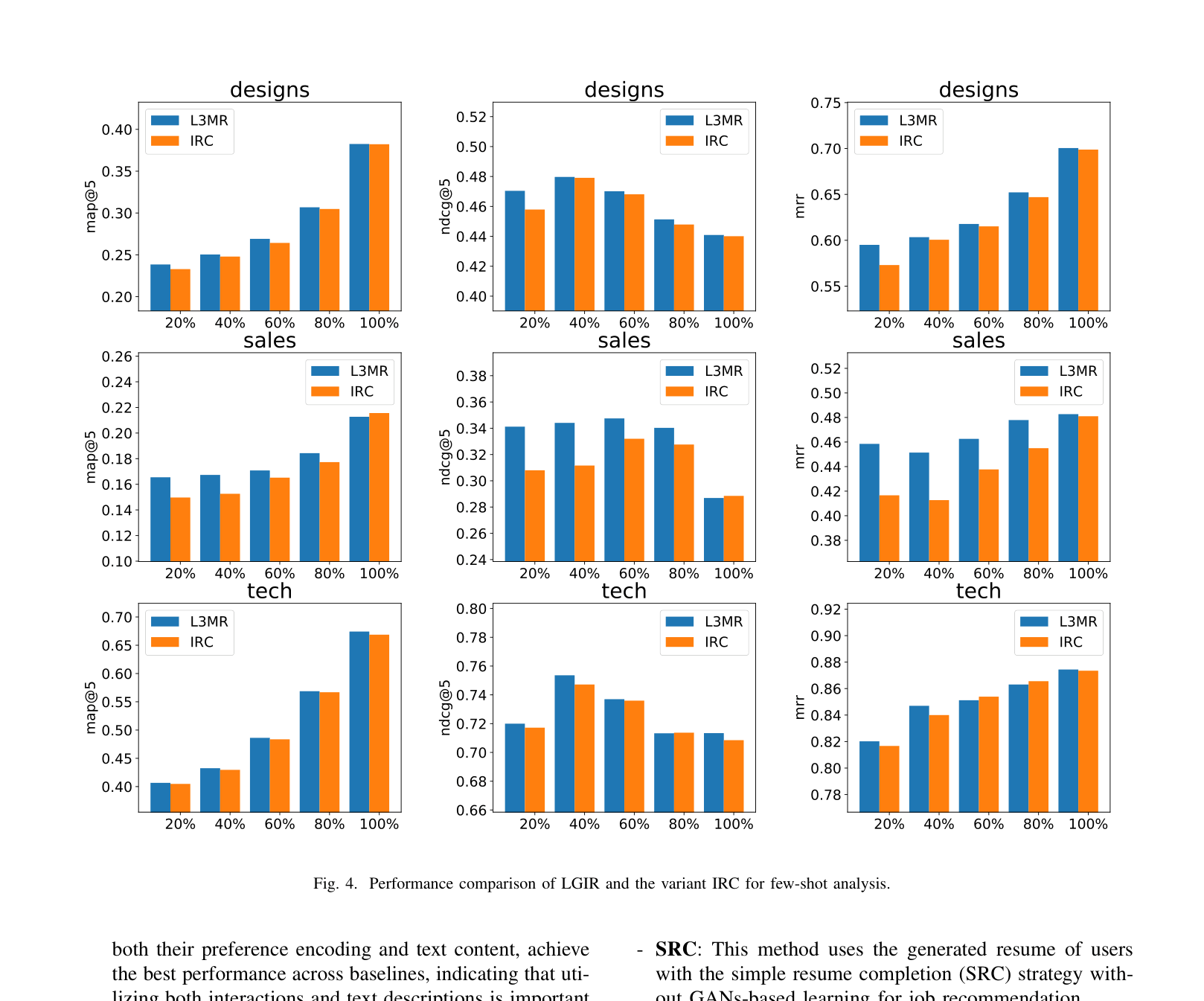
Job recommendation systems struggle with low-quality user resumes (missing skills) and the 'few-shot' problem where users with limited interaction history provide insufficient data for models to generate accurate profiles.
Why it matters:
- Users frequently upload incomplete resumes or lack self-awareness of their skills, leading to poor matches in recruitment platforms
- LLMs can hallucinate (fabricate) information when generating resumes for users with little data, worsening the recommendation quality rather than improving it
- Existing hybrid methods fail to effectively bridge the gap between users with rich interaction histories and long-tail users with sparse records
Concrete Example:
A user might upload a sparse resume listing only 'UI Design'. A standard LLM might hallucinate unrelated projects to fill space. However, if the user clicked on 'Senior App Designer' jobs, LGIR infers implicit skills (e.g., 'Mobile UI', 'Prototyping') to prompt the LLM correctly, then uses a GAN to ensure this generated profile matches the statistical quality of highly active users.
Key Novelty
LLM-based GANs Interactive Recommendation (LGIR)
- Interactive Resume Completion (IRC): Prompts an LLM not just with the raw resume, but with implicit characteristics inferred from the user's historical job interactions (e.g., agreed interviews)
- GAN-based Alignment: Uses a Generative Adversarial Network to transfer knowledge from 'many-shot' users (rich history) to 'few-shot' users, forcing the embeddings of sparse generated resumes to resemble high-quality ones
Architecture
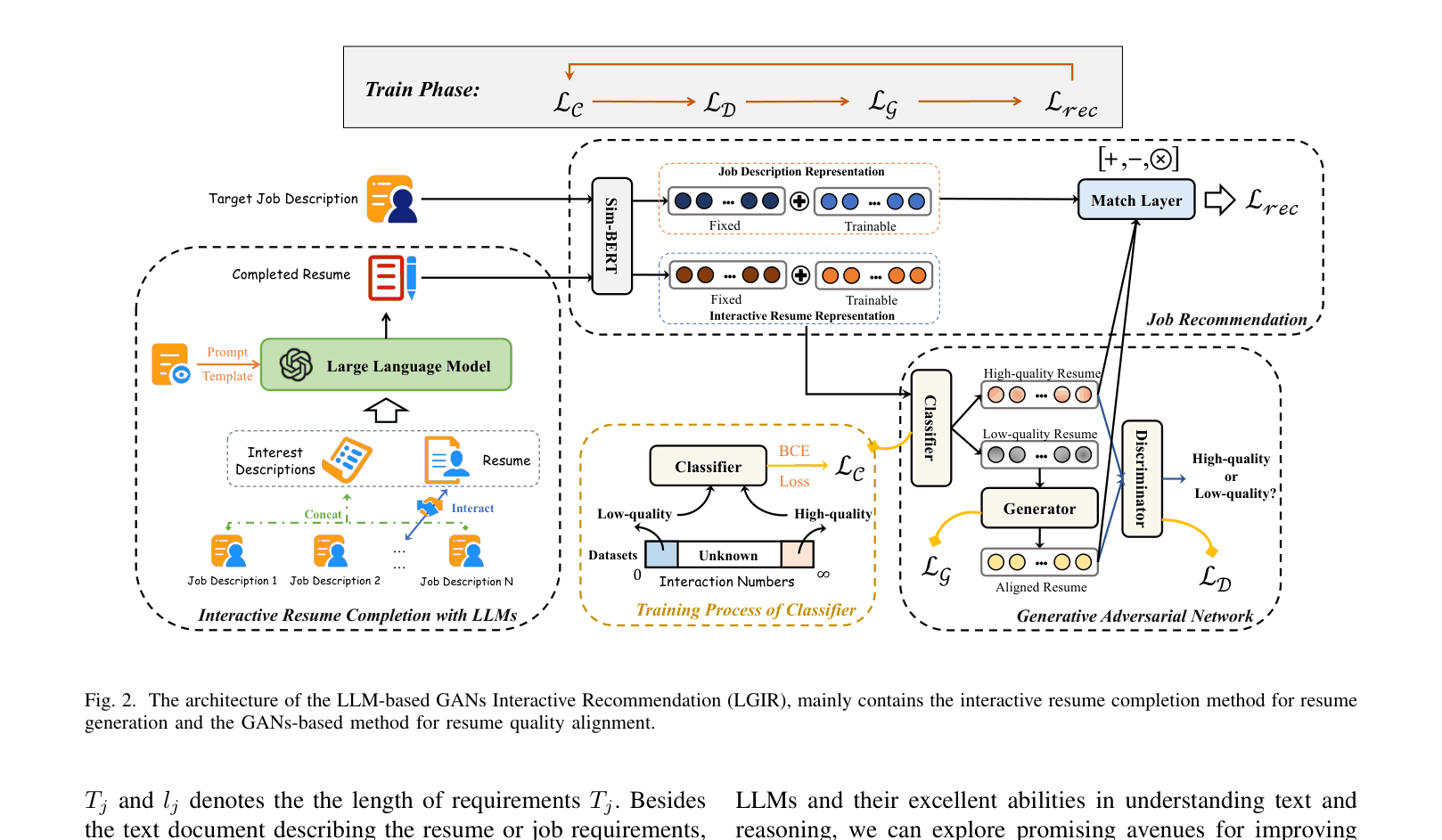
The LGIR framework architecture, illustrating the parallel processes of Interactive Resume Completion via LLM and the GAN-based representation alignment.
Evaluation Highlights
- Outperforms state-of-the-art LightGCN by +8.38% on MAP@5 on the Designs dataset
- Achieves +7.50% improvement in MAP@5 on the Sales dataset compared to the best baseline
- Consistent improvements across three real-world datasets (Designs, Sales, Tech) covering over 80,000 users
Breakthrough Assessment
7/10
Novel combination of LLM-based profile augmentation with GAN-based feature alignment for the long-tail problem. Solid empirical results on real-world data.