📝 Paper Summary
Recommendation Unlearning
Retrieval-Augmented Generation (RAG) for RecSys
CRAGRU reframes recommendation unlearning as a retrieval filtering task, using an LLM to generate recommendations from sanitized user history without modifying the underlying model parameters.
Core Problem
Traditional unlearning methods (retraining or parameter updates) are computationally expensive and introduce propagation bias, where removing one user's data degrades recommendations for behaviorally similar users.
Why it matters:
- Privacy regulations like GDPR mandate the 'right to be forgotten', requiring systems to remove user data upon request
- Existing exact unlearning methods (e.g., SISA) damage the utility of the model for remaining users due to collaborative entanglement
- High-frequency unlearning requests make full retraining of large-scale recommender systems computationally prohibitive
Concrete Example:
If User A (a Harry Potter fan) requests their data be unlearned, parameter-update methods might inadvertently shift the embeddings for the 'Fantasy' genre, degrading recommendations for User B (another Harry Potter fan) who did not request unlearning.
Key Novelty
CRAGRU (Customized RAG for Recommendation Unlearning)
- Decouples unlearning from model training: instead of updating weights, it filters the *retrieval context* (user history) fed to the LLM
- Treats recommendations as user-level atomic units, preventing the removal of one user's data from affecting others (zero propagation bias)
- employs three specific interaction retrieval strategies (Preference, Diversity, Attention) to select the most informative history for the LLM prompt while respecting unlearning requests
Architecture
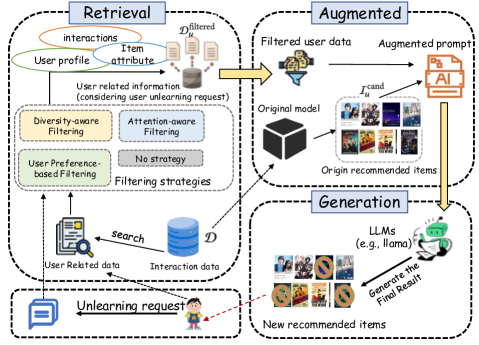
The overall CRAGRU framework illustrating the three stages: Retrieval, Augmentation, and Generation.
Evaluation Highlights
- Reduces average unlearning time by 4.5x compared to state-of-the-art baselines (e.g., SISA, RecEraser)
- Retains approximately 90% of the original recommendation model's performance after unlearning
- Eliminates unlearning bias by design, as no shared model parameters are updated during the unlearning process
Breakthrough Assessment
7/10
Novel application of RAG to solve the specific problem of propagation bias in unlearning. While the RAG concept is known, applying it to avoid parameter updates for privacy is a clever reframing of the problem.