Yi Xu, Weicong Qin, Weijie Yu, Ming He, Jianping Fan, Jun Xu
Renmin University of China,
University of International Business and Economics,
AI Lab at Lenovo Research
arXiv
(2025)
RecommendationP13N
📝 Paper Summary
In-Context Learning (ICL)Theoretical Analysis of LLMs
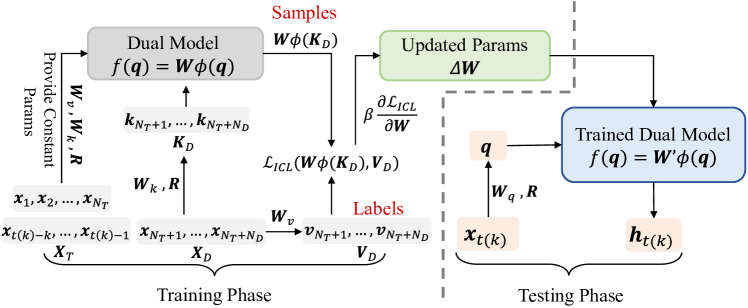
The LRGD model mathematically proves that generating recommendation tokens via In-Context Learning is equivalent to performing gradient descent on a dual model, enabling theoretically-grounded demonstration selection and optimization.
Core Problem
While In-Context Learning (ICL) improves LLM recommendations without fine-tuning, there is no theoretical understanding of why it works or how to principledly select and optimize demonstrations.
Why it matters:
Current few-shot methods rely on trial-and-error for demonstration selection, lacking a metric to quantify demonstration quality
The lack of theoretical grounding prevents the design of robust optimization strategies, limiting scalability and stability in real-world recommendation scenarios
Existing theoretical analyses of ICL often ignore critical components like Rotation Positional Encoding (RoPE) and multi-layer architectures, making them inapplicable to modern LLM recommenders
Concrete Example:A recommender might randomly select a user's past purchase history as a demonstration. Without a metric like the proposed Effect_D, the system cannot determine if these specific examples actually help the model 'converge' to the correct user preference or if they introduce noise, leading to inconsistent recommendations.
Establishes a mathematical equivalence between the LLM's attention-based token generation and a gradient descent step in a 'dual' linear model
Generalizes previous linear attention theories to include practical LLM components like Rotation Positional Encoding (RoPE) and multi-layer Transformer architectures
Introduces a new metric, Effect_D, which measures demonstration quality by calculating how much a specific demonstration accelerates the dual model's convergence toward the target item
Architecture
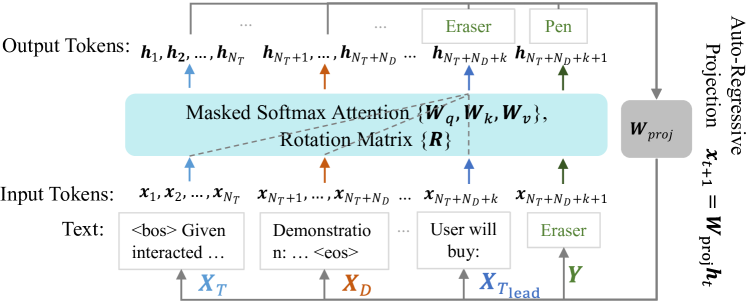
The structure of the input sequence X and the auto-regressive generation process for recommendation.
Breakthrough Assessment
8/10
Provides a significant theoretical bridge between ICL and optimization theory specifically for recommendations, addressing the 'black box' nature of prompt engineering with rigorous math (RoPE, multi-layer) and a practical optimization metric.
⚙️ Technical Details
Problem Definition
Setting: LLM-based Sequential Recommendation using In-Context Learning (ICL)
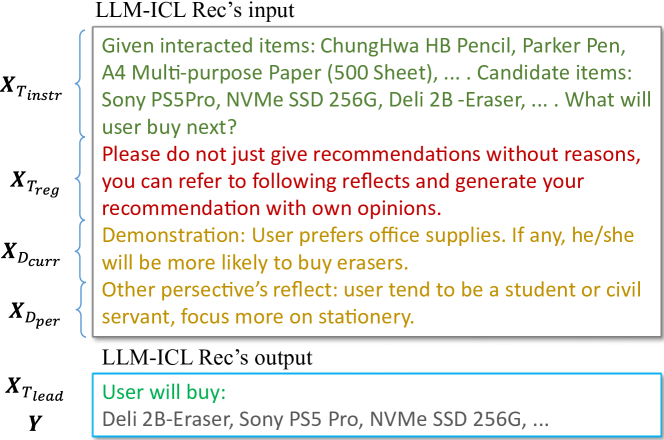
Inputs: Input sequence X containing task instructions (X_T) and demonstrations (X_D) representing user history
Outputs: A ranked list of recommended items Y generated auto-regressively
Pipeline Flow
User Data Processing (Input Construction)
Demonstration Optimization (Two-Stage Process)
Dual Model Gradient Descent (Theoretical Inference View)
System Modules
Input Constructor
Combines task instructions, generated reasoning (Chain of Thought), and user preference demonstrations into a sequence
Model or implementation: Generic LLM (Transformer-based)
Effect_D Evaluator (Optimization)
Calculates the quality of potential demonstrations by measuring their impact on dual model convergence
Model or implementation: LRGD Analytical Formula
Demonstration Refiner (Optimization)
Applies perturbations to demonstrations and regularizations to instructions to simulate robust gradient descent
Model or implementation: Mathematical Transformation
Novel Architectural Elements
Integration of Rotation Positional Encoding (RoPE) into the dual gradient descent formulation
Formulation of demonstration selection as a convergence acceleration problem in the dual space
Two-stage optimization pipeline: (1) Generate candidates, (2) Refine via perturbation/regularization derived from LRGD theory
Modeling
Base Model: Multi-layer Decoder-only Transformer (Theoretical analysis applicable to standard LLMs)
Training Method: In-Context Learning (Inference-only optimization)
Objective Functions:
Purpose: Minimize the difference between the dual model's prediction and the target token (demonstration label).
Formally: L_ICL = 1/2 || W phi(K_D) - V_D ||^2_F + lambda || W ||^2_F
Adaptation: Demonstration Optimization (Prompt Engineering via Theory)
Key Hyperparameters:
beta: Effective learning rate for the dual model (derived from attention scaling factors)
Comparison to Prior Work
vs. LLM4RS/LLMRank: LRGD provides a theoretical 'why' and a metric for optimization, rather than heuristic prompt design
vs. Ren and Liu (2024): LRGD incorporates RoPE, multi-layer architectures, and specific recommendation contexts (sequential generation), whereas prior work focused on simplified linear attention models
Limitations
The kernel method is an approximation of Softmax, not an exact identity
Computational cost of calculating Effect_D for all candidate demonstrations involves matrix operations
Analysis assumes the dual model linear structure holds sufficiently for deep non-linear Transformers
Reproducibility
The paper provides detailed mathematical proofs in the main text and appendices (referenced). Code URL is not provided in the abstract or introduction. The theoretical derivation explicitly handles RoPE and multi-layer Transformers, aiding implementation.
📊 Experiments & Results
Evaluation Setup
Sequential Recommendation using Amazon datasets
Benchmarks:
Amazon Beauty (Sequential Recommendation)
Amazon Toys (Sequential Recommendation)
Amazon Sports (Sequential Recommendation)
Metrics:
Effect_D (Proposed metric for demonstration quality)
Recommendation Performance (Implied, likely NDCG/HR but specific metrics not listed in text)
Statistical methodology: Not explicitly reported in the paper
Experiment Figures
Illustration of the LRGD inference mechanism mapping Attention to Gradient Descent.
The Training-Testing round view of token generation.
Main Takeaways
The generation of recommendation tokens in LLM-ICL is mathematically equivalent to a gradient descent process.
Demonstrations act as training samples for the dual model, updating its weights to better predict the next token.
The proposed Effect_D metric allows for the systematic selection of demonstrations that maximize convergence speed.
Sequential token generation shifts the starting point of the gradient descent for each new token, incorporating previous outputs into the context.
Dual Model: A theoretical linear model constructed such that its gradient descent update step is mathematically equivalent to the attention mechanism's output
RoPE: Rotary Positional Embedding—a method for encoding position information in Transformers by rotating query and key vectors
Effect_D: A proposed metric that quantifies the quality of a demonstration by measuring its contribution to the gradient descent convergence speed in the dual model
ICL: In-Context Learning—the ability of LLMs to learn tasks from examples in the prompt without parameter updates
ZSL: Zero-Shot Learning—generating recommendations without any example demonstrations
FSL: Few-Shot Learning—generating recommendations using a small set of example demonstrations (synonymous with ICL here)