📝 Paper Summary
LLM Agents for Recommendation
Human-Centered AI
RAH introduces an LLM-based assistant that acts as an intermediary between users and recommender systems, learning user personalities to generate proxy feedback that mitigates bias and reduces user burden.
Core Problem
Recommender systems struggle with balancing accuracy and satisfaction, addressing biases (like popularity bias), and managing cold-start problems without burdening users with excessive feedback requests.
Why it matters:
- Users are often passive recipients of recommendations with little control over privacy or specific filtering needs.
- Cold-start problems in new domains usually require tedious manual feedback from users.
- Standard feedback loops reinforce selection bias, as users typically only rate popular or seen items, neglecting the 'long tail'.
Concrete Example:
A user who dislikes violent movies might still get recommended 'Batman: The Dark Knight' because it is popular. In RAH, the assistant knows the user's specific dislike for violence, intercepts the recommendation, acts as a proxy to 'Dislike' it, and filters it out before the user sees it.
Key Novelty
LLM-based Assistant as an Active Intermediary
- Introduces an 'Assistant' layer between the User and the RecSys, consisting of five specialized agents (Perceive, Learn, Act, Critic, Reflect).
- Uses a 'Learn-Act-Critic' loop where the assistant iteratively refines its internal model of the user until it can accurately predict their reactions.
- Employs a 'Reflection' mechanism to resolve conflicts in learned user profiles (e.g., clashing likes/dislikes) before generating proxy actions.
Architecture
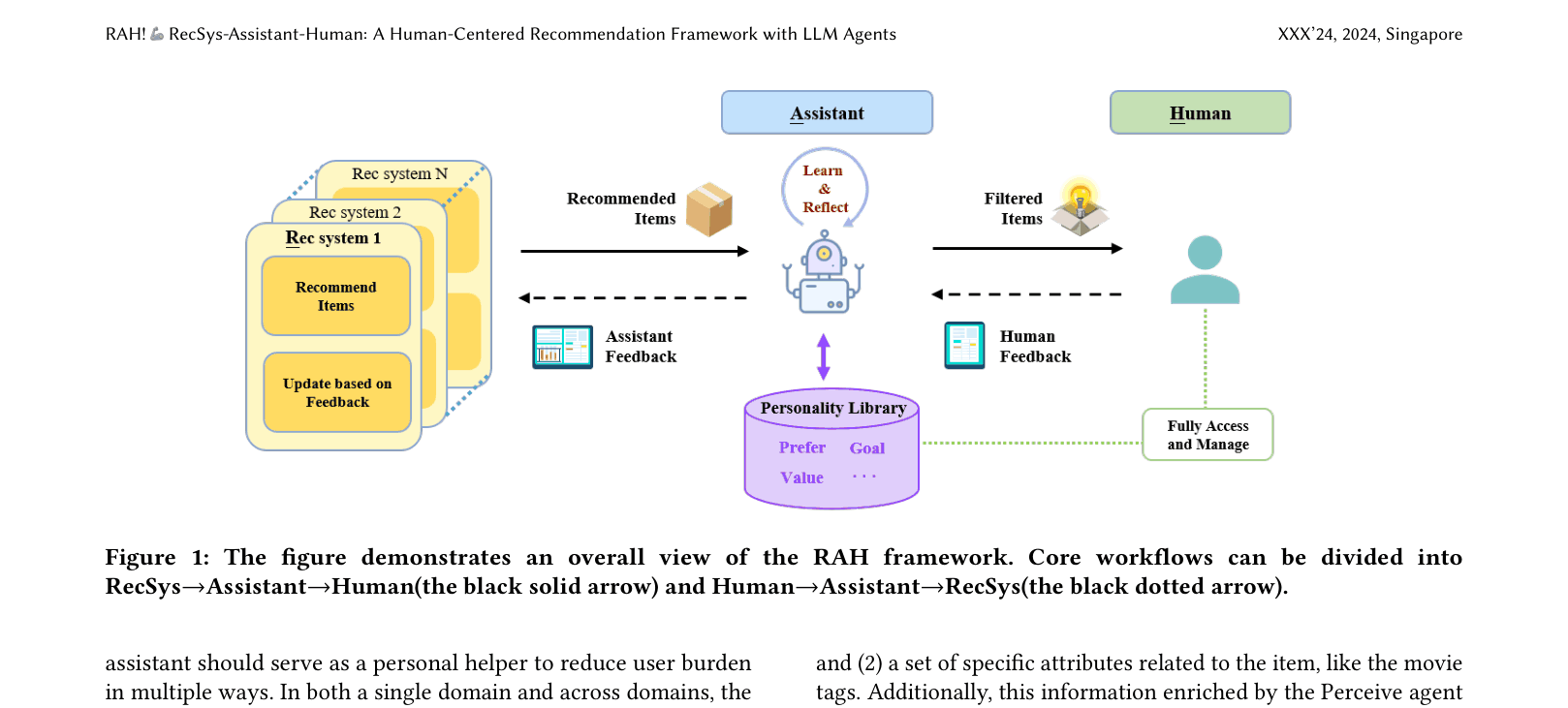
The overall RAH framework showing the interaction between the Recommender System, the Assistant, and the Human.
Evaluation Highlights
- LightGCN with RAH proxy feedback improves NDCG@10 by +0.0871 in the Book domain compared to standard LightGCN.
- Combined with Inverse Propensity Scoring (IPS), RAH improves debiasing performance on Matrix Factorization, raising NDCG@10 from 0.1835 (baseline) to 0.5196.
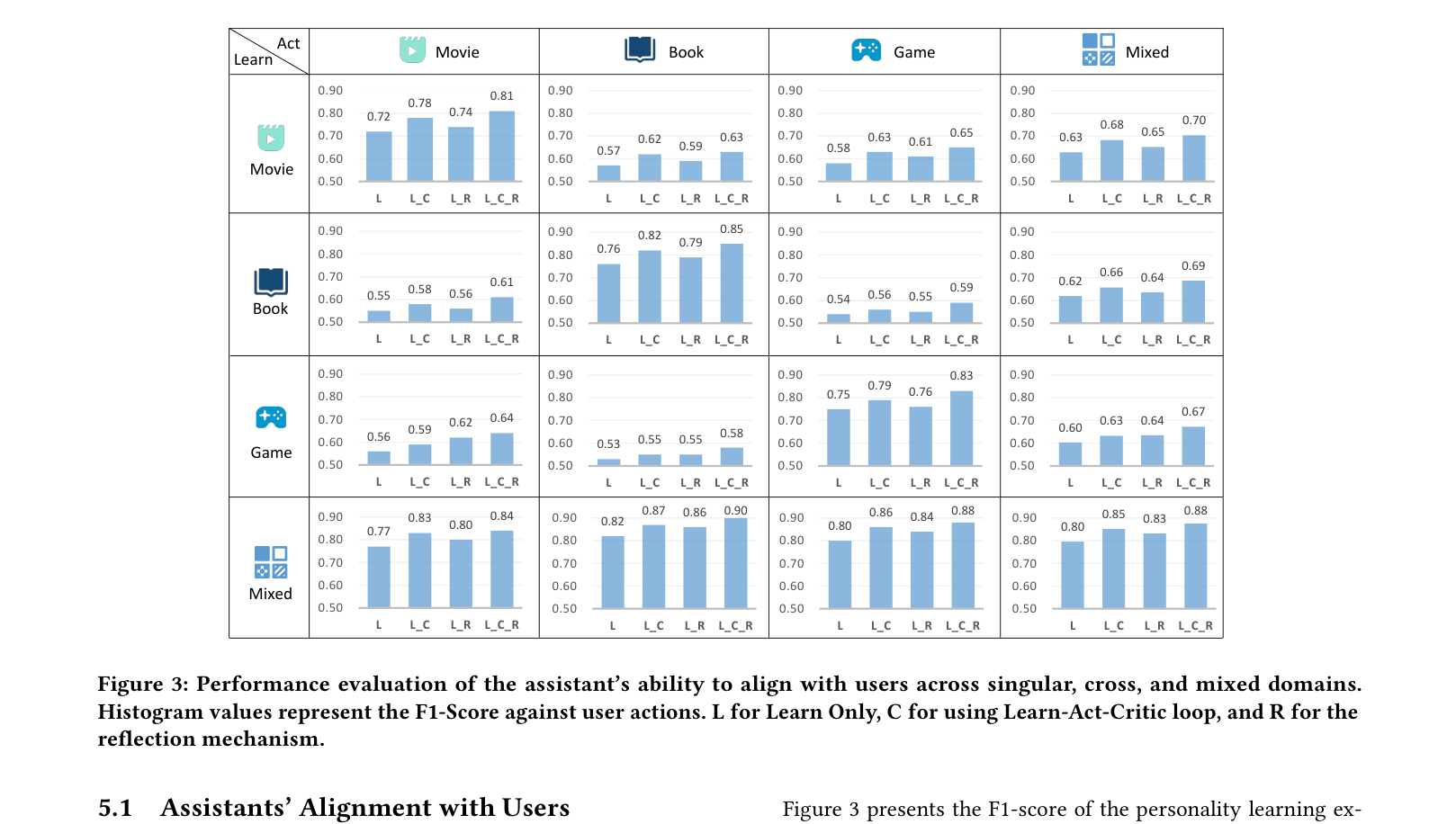
- The Learn-Act-Critic loop combined with Reflection improves user alignment F1-score from ~0.76 (Learn Only) to ~0.85 in cross-domain settings.
Breakthrough Assessment
7/10
Proposes a novel, modular agent framework for shifting the burden of interaction from humans to LLMs. Strong conceptual contribution to human-centered AI, though evaluation is primarily offline/simulated.