📊 Experiments & Results
Evaluation Setup
Link prediction on Amazon product graphs (Electronics, Cell Phones, Grocery, Home).
Benchmarks:
- Amazon Electronics (Complementary Product Recommendation)
- Amazon Cell Phones (Complementary Product Recommendation)
- Amazon Grocery (Complementary Product Recommendation)
- Amazon Home (Complementary Product Recommendation)
Metrics:
- Hit@K (Accuracy)
- NDCG@K (Ranking Quality)
- Entropy (Diversity of token distribution)
- Vocabulary Size (Diversity)
- Statistical methodology: Not explicitly reported in the paper
Key Results
| Benchmark | Metric | Baseline | This Paper | Δ |
|---|---|---|---|---|
| Results on Amazon Cell Phones dataset showing improvement from the proposed Div.+Acc. pipeline over baselines. | ||||
| Amazon Cell Phones | Hit@1 | 1.154 | 1.351 | +0.197 |
| Amazon Cell Phones | Hit@1 | 1.087 | 1.326 | +0.239 |
| Amazon Cell Phones | NDCG@1 | 1.087 | 1.326 | +0.239 |
| Amazon Cell Phones | Vocabulary Size | 19.5 | 20.8 | +1.3 |
| Results on Amazon Home dataset demonstrating gains in ranking quality. | ||||
| Amazon Home | Hit@1 | 3.383 | 3.704 | +0.321 |
| Amazon Home | NDCG@1 | 3.354 | 3.564 | +0.210 |
Experiment Figures
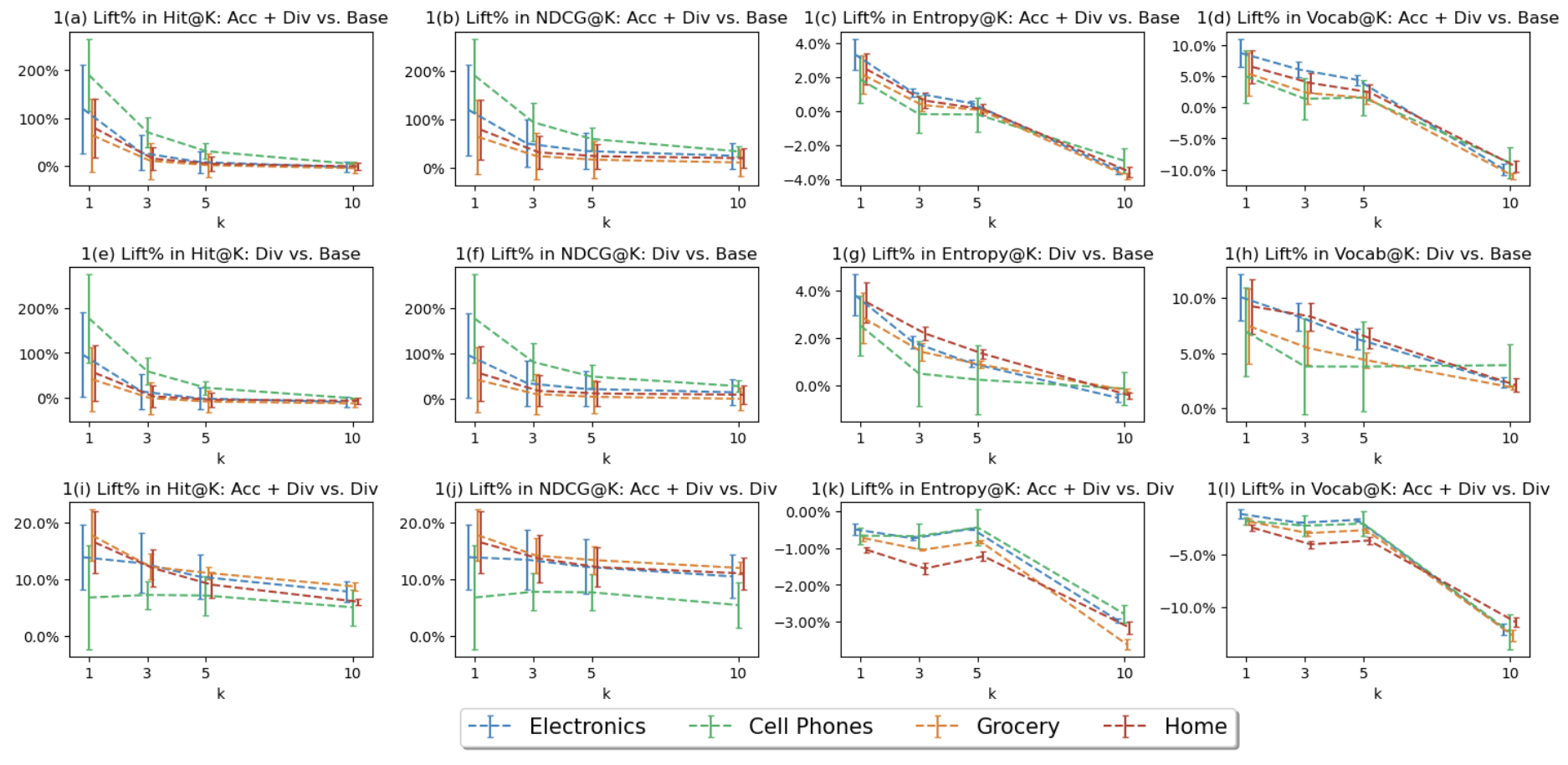
Lift percentage in accuracy and diversity metrics by dataset and method.
Main Takeaways
- The Diversity Agent alone improves both accuracy and diversity metrics at lower K values (K=1), suggesting that diversifying top recommendations also helps retrieve relevant items missed by the GNN.
- The Accuracy Agent further boosts precision metrics (Hit Rate, NDCG) but consistently reduces diversity metrics (Entropy, Vocab) compared to the Diversity Agent's output, confirming the accuracy-diversity tradeoff.
- The method is robust across different underlying GNN architectures (GraphSAGE, GAT, SComGNN), delivering consistent gains without retraining the base models.