📝 Paper Summary
LLM-based Recommendation
Streaming Recommendation
In-Context Learning
RecICL enables Large Language Models to adapt to real-time user interest shifts without parameter updates by training them to perform in-context learning using recent interaction examples.
Core Problem
Standard LLM-based recommenders require expensive retraining to capture evolving user interests, and simply adding recent examples at inference fails because fine-tuned models often lose their general in-context learning abilities.
Why it matters:
- Real-world user interests drift rapidly, requiring systems to update frequently to remain effective
- Fine-tuning LLMs (even efficiently) is too computationally expensive and slow for real-time streaming recommendation scenarios
- Existing instruction-tuned recommenders suffer from 'catastrophic forgetting' of the ability to learn from context, making standard few-shot prompting ineffective
Concrete Example:
In a book recommendation scenario, a user's interest might shift from 'History' to 'Sci-Fi' over a few days. A model trained on data up to last week (f4) fails to recommend Sci-Fi books on new data (D9), leading to a performance drop, whereas a retrained model (f8) succeeds but costs too much to deploy constantly.
Key Novelty
Recommendation-Specific In-Context Learning (RecICL)
- Constructs training data in an In-Context Learning (ICL) format, where each sample includes a few recent user interactions as 'demonstrations' within the prompt itself
- Explicitly fine-tunes the LLM to rely on these in-context examples to make predictions, preserving and aligning the model's ICL capability with the recommendation task
- Enables the model to adapt to new user interests during inference simply by swapping the context examples, without any weight updates
Architecture
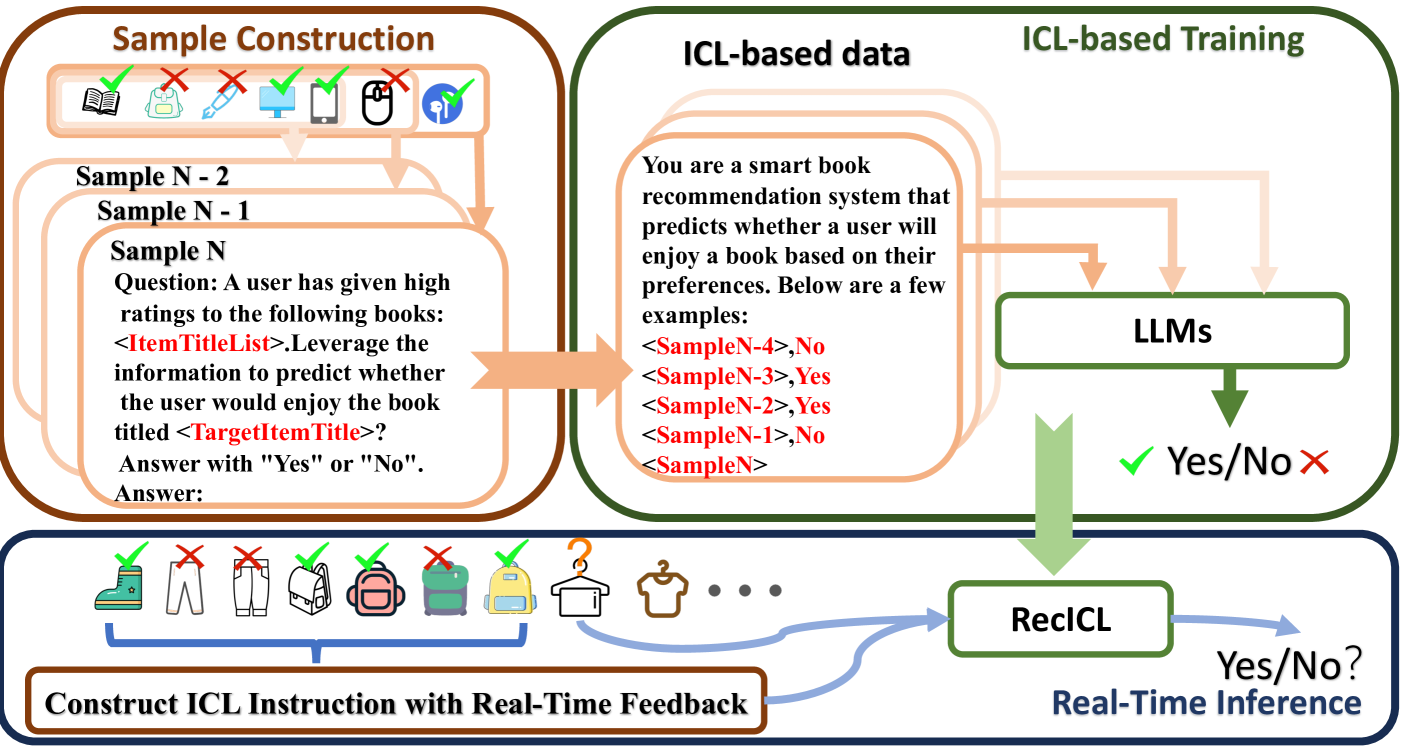
The RecICL framework comprising Sample Construction, ICL-based Tuning, and Real-time Inference.
Evaluation Highlights
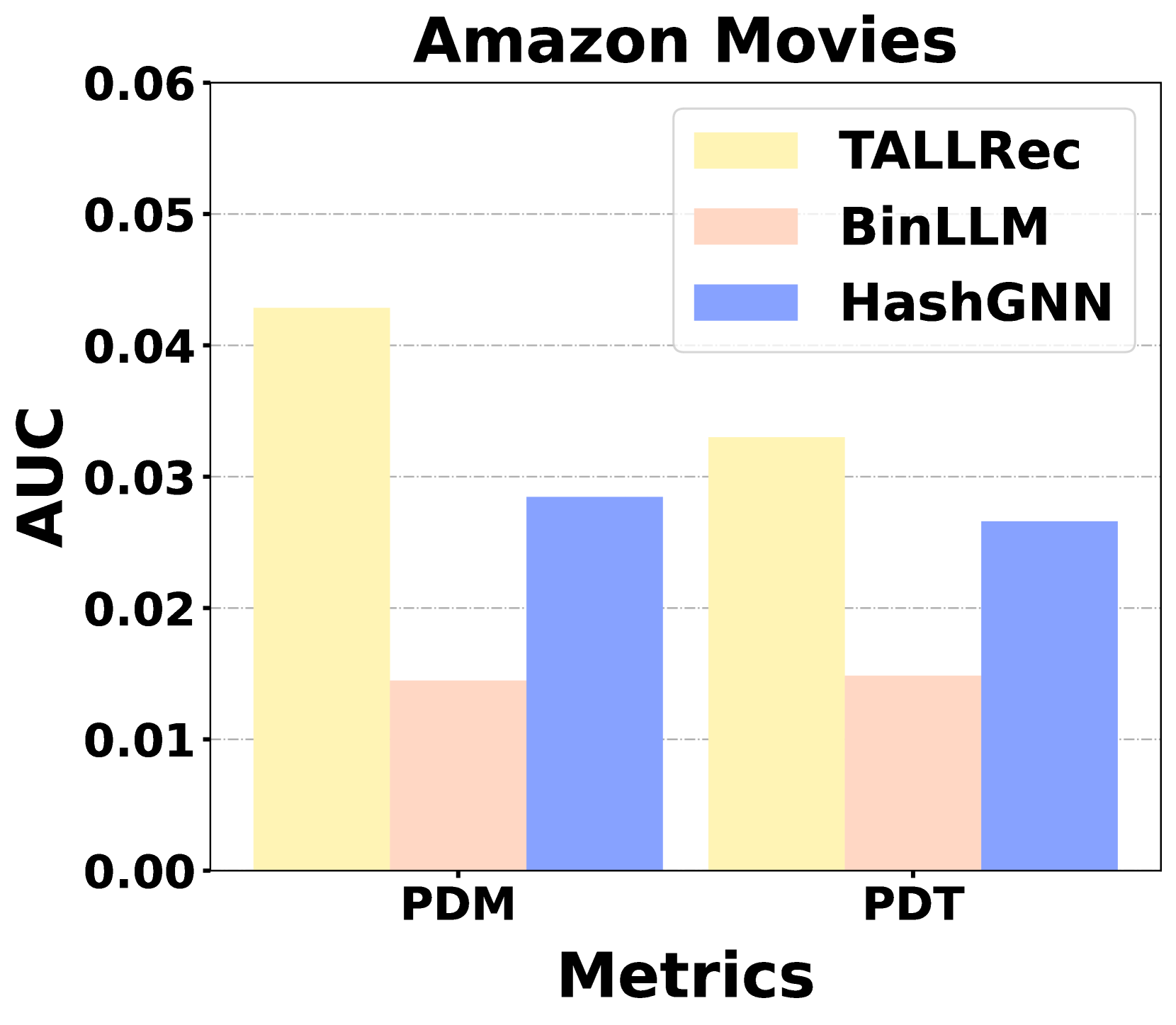
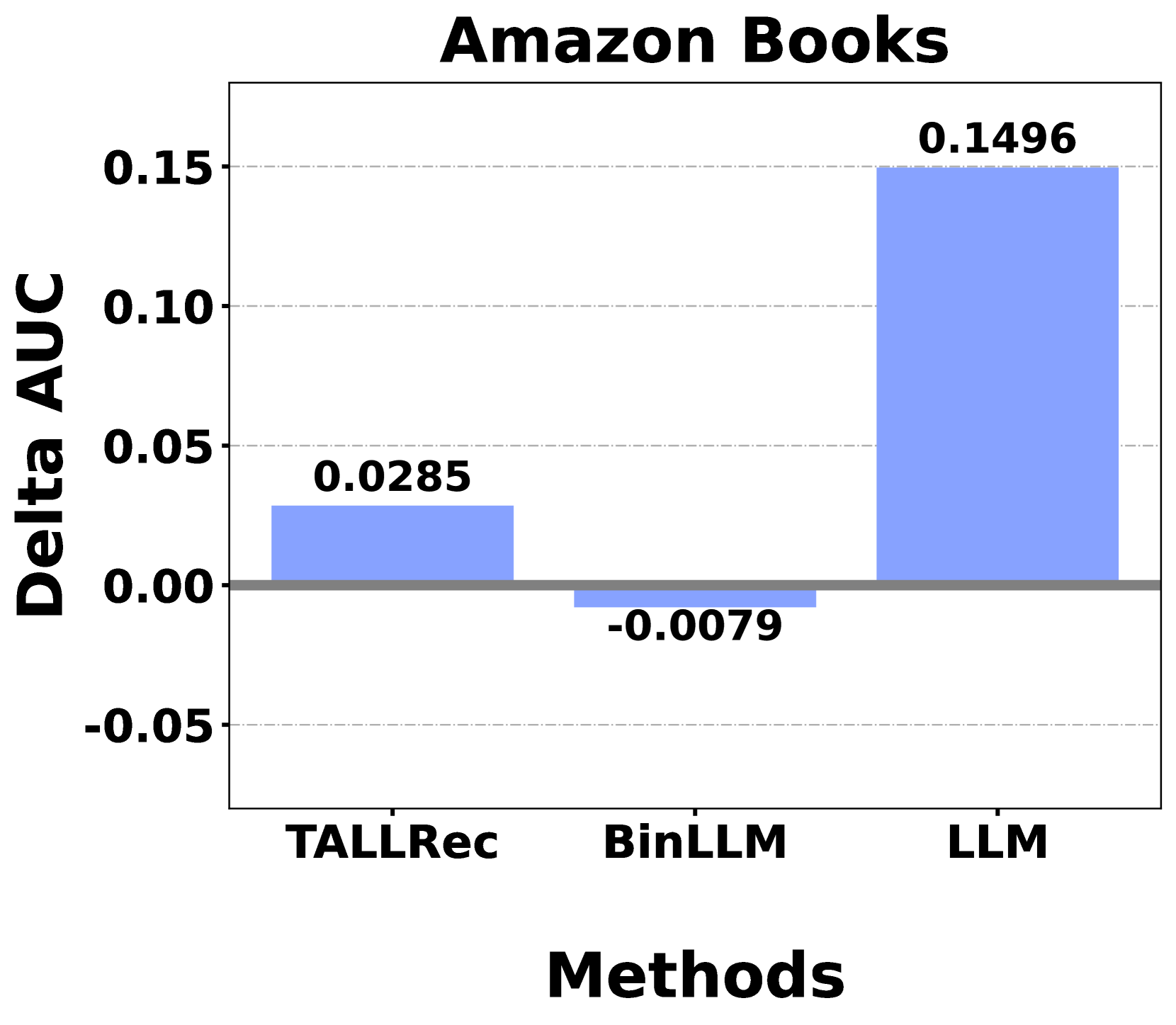
- Significant performance retention over time: RecICL maintains high AUC on future data (e.g., D9) without updates, unlike baselines (TALLRec, BinLLM) which degrade
- Outperforms standard LLM fine-tuning methods that lack ICL-aligned training when tested on streaming data scenarios
- Effective adaption: Demonstrates that the model can successfully utilize recent interaction history provided in the prompt to capture interest drift
Breakthrough Assessment
7/10
Offers a practical solution to the high cost of updating LLMs for recommendation. The idea of 'tuning for ICL' is gaining traction, and applying it to prevent staleness in recommenders is a valuable, specific contribution.