📝 Paper Summary
Explainable Recommendation
Knowledge Graph Reasoning
LLM-SRR enhances recommender systems by using LLMs to extract subjective preferences from reviews into a knowledge graph, then applying subgraph reasoning to generate accurate, explainable recommendations.
Core Problem
Constructing Knowledge Graphs (KGs) from unstructured reviews is difficult for traditional tools that miss subjective info, and existing KG reasoning fails in cross-selling scenarios where links between product lines are sparse.
Why it matters:
- Traditional information extraction fails to capture complex subjective semantics (e.g., emotions, preferences) inherent in user reviews, leading to noisy or incomplete KGs
- Rule-based reasoners cannot find paths in 'cross-selling' scenarios (e.g., between different business units) where explicit links don't exist, causing 'recommendation hallucination'
- Lack of interpretability in standard recommender systems reduces user trust and hampers decision-making for business analysts
Concrete Example:
In a multinational company (METC), different units sell washing machines and dryers separately. A traditional KG lacks links between these units. LLM-SRR extracts 'I like METC's wash machine colour' from a review to build a new 'like' relation, enabling the system to reason across units and recommend a matching dryer.
Key Novelty
LLM-powered Subgraph Reasoning for Recommendation (LLM-SRR)
- Augments Knowledge Graph (KG) construction by using LLMs to decompose user reviews into new entities and relations (e.g., preferences, emotions), enriching the graph with subjective paths
- Employes an attention-based subgraph reasoning module that diffuses scores from a central user node to identify potential item links, effectively skipping hops to find distant connections
- Generates post-hoc natural language explanations by feeding the identified reasoning paths and keywords back into an LLM
Architecture
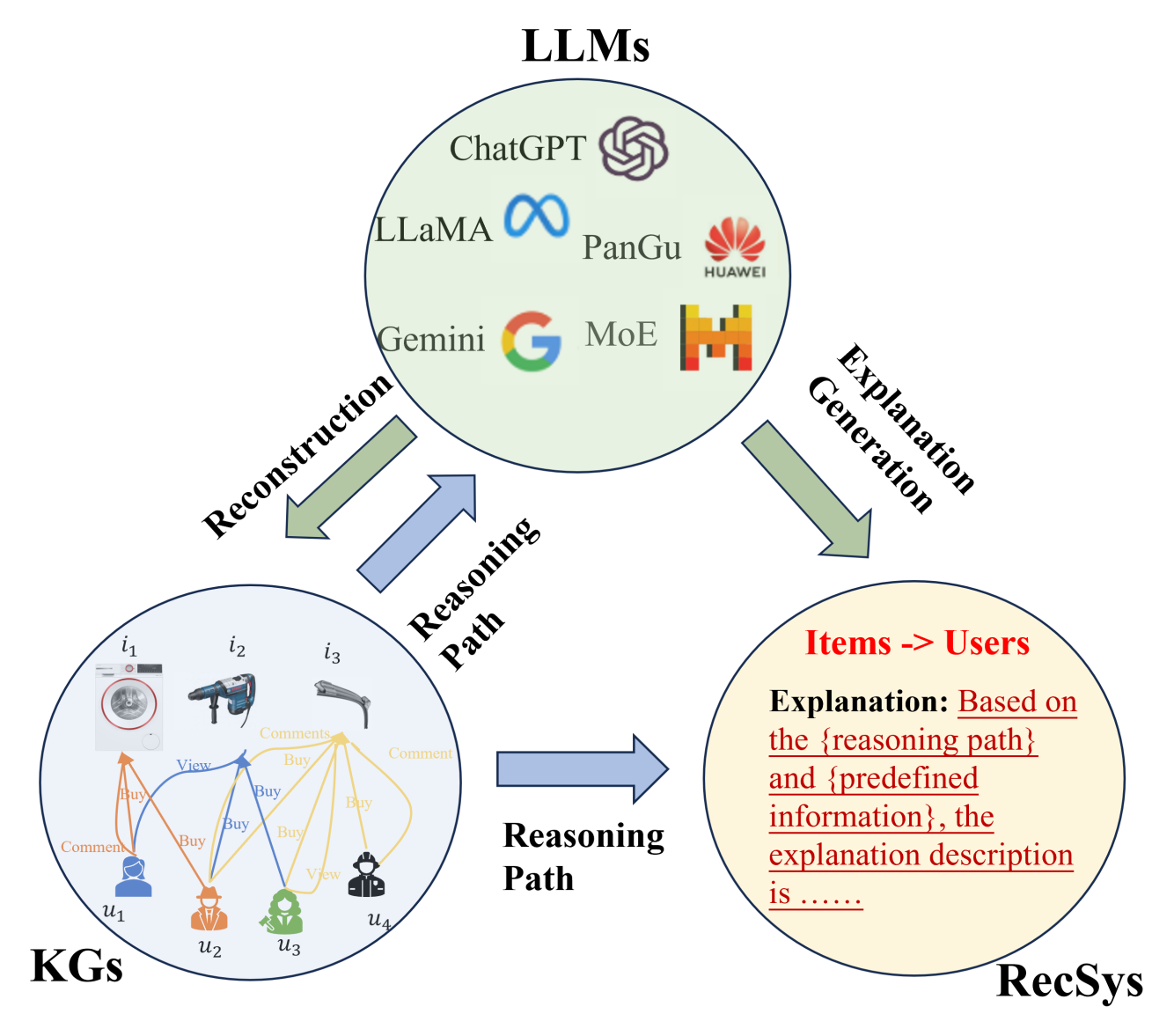
The LLM-SRR framework architecture showing the three-step process: Information Extraction, Subgraph Reasoning, and Explanation Generation.
Evaluation Highlights
- Achieves an average performance improvement of 12% over state-of-the-art techniques across four real-world datasets (Amazon-Beauty, Cellphones, Clothing, and METC)
- Successfully deployed in a real-world cross-selling scenario at a multinational engineering and technology company (METC), facilitating sales across different business units
Breakthrough Assessment
7/10
Novel integration of LLMs for both KG construction (pre-processing) and explanation (post-processing), sandwiched around a subgraph reasoning core. Practical validation in a real corporate setting is strong.