📝 Paper Summary
Federated Sequential Recommendation
Privacy-Preserving Recommendation
LLM as a Service (LLMaaS)
FELLAS improves federated sequential recommendation by querying external LLMs for item and sequence embeddings, using privacy-preserving perturbation and contrastive learning to securely transfer knowledge to client models.
Core Problem
Federated sequential recommendation (FedSeqRec) models must be lightweight for edge devices, resulting in poor performance compared to centralized models, while powerful LLMs are too resource-intensive to run locally or fine-tune federatedly.
Why it matters:
- Traditional centralized training poses significant data leakage risks and violates privacy regulations like GDPR and CCPA.
- Existing solutions either sacrifice performance for privacy (lightweight models) or incur impractical communication/compute costs (fine-tuning LLMs on-device).
- Directly using external LLM APIs with raw user data violates the core privacy principles of federated learning.
Concrete Example:
A client wants to use a powerful external LLM to encode their shopping history [Laptop, Mouse, HDMI Cable] to get better recommendations. Sending this raw sequence to the LLM server exposes private interests. Existing methods force the client to use a weaker local model instead.
Key Novelty
Federated Sequential Recommendation with LLM as External Service (FELLAS)
- Treats the LLM as a remote 'oracle' service rather than a local backbone, querying it for item-text and sequence-context embeddings to augment lightweight local models.
- Implements a 'd_chi-privacy' perturbation mechanism that shuffles and alters user sequences before sending them to the LLM, ensuring the external server sees only noisy, plausible data.
- Uses contrastive learning to align the client's local model representations with the semantic knowledge returned by the LLM from the noisy sequences.
Architecture
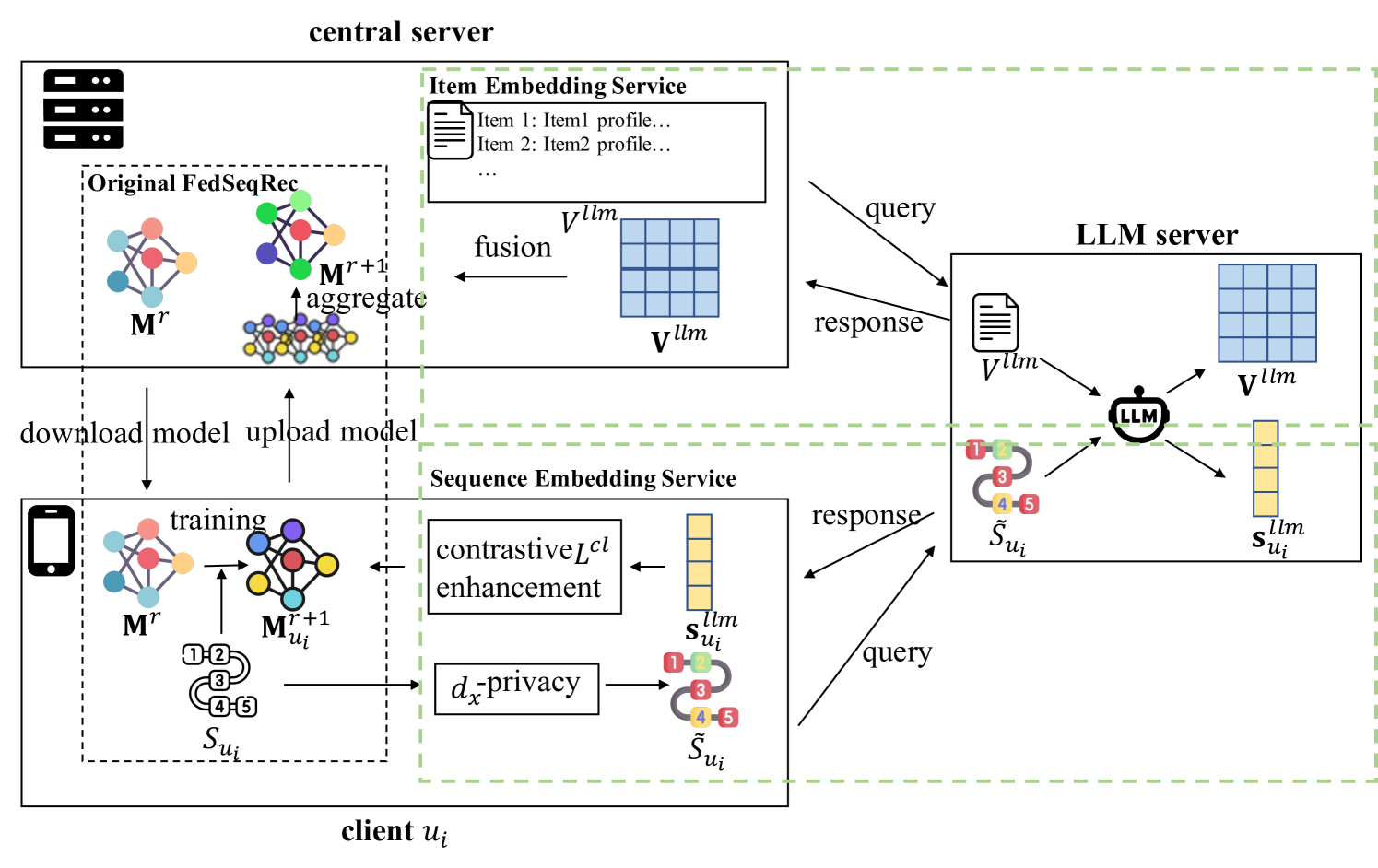
The FELLAS architecture, illustrating the interactions between Clients, the Central Server, and the External LLM Server.
Evaluation Highlights
- Demonstrates effectiveness on three Amazon datasets (Beauty, Office Products, Patio Lawn and Garden) using SASRec and BERT4Rec backbones.
- Validates privacy protection against two novel inference attacks (SIA and SIAUI) where the LLM server and central server act as adversaries.
Breakthrough Assessment
7/10
A practical architectural shift for FedRec that bridges the gap between lightweight edge models and powerful cloud LLMs without compromising the 'no-raw-data-sharing' rule of federated learning.