📝 Paper Summary
LLM-based Recommendation
Knowledge Graph-enhanced Recommendation
PIDLR improves LLM recommendations by mining collaborative preference hints from similar users in a knowledge graph and translating them into concise textual prompts to overcome interaction sparsity and reduce noise.
Core Problem
Directly feeding historical interactions into LLMs fails for unseen items due to data sparsity, while feeding all item attributes introduces excessive noise that overwhelms the model.
Why it matters:
- Sparse user histories often lack the specific attribute signals needed to explain why a user might like a totally new item
- Item metadata is often vast (e.g., 66 attributes per movie), creating noisy, long contexts that distract LLMs from key decision factors
- Existing methods that fuse ID embeddings with LLMs suffer from a semantic gap between continuous latent spaces and the LLM's discrete text space
Concrete Example:
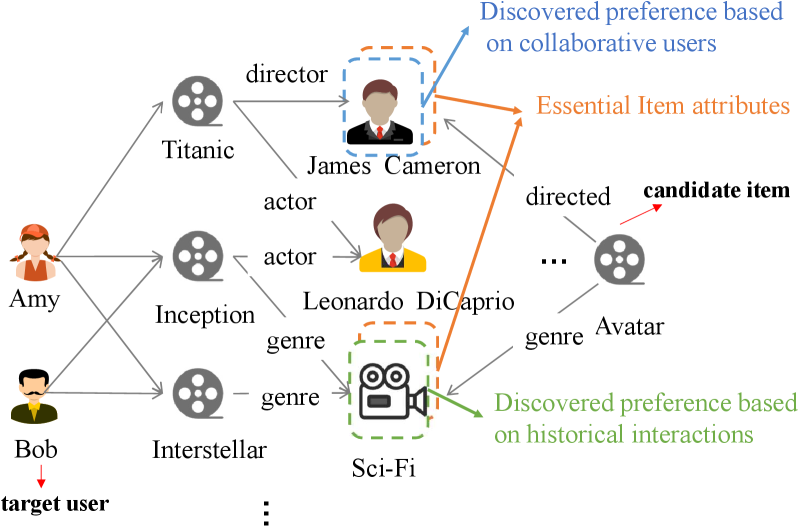
Bob likes 'Interstellar' (Sci-Fi), but has never interacted with director James Cameron. A standard model sees no link to 'Titanic'. PIDLR infers Bob might like Cameron because similar users do, explicitly adding this 'hint' to the prompt.
Key Novelty
Preference hInt Discovery-based LLM Recommendation (PIDLR)
- Collaborative Hint Extraction: Infers a user's potential preferences for unseen attributes by looking at the knowledge graph neighborhoods of similar users (collaborative filtering principle applied to KG paths)
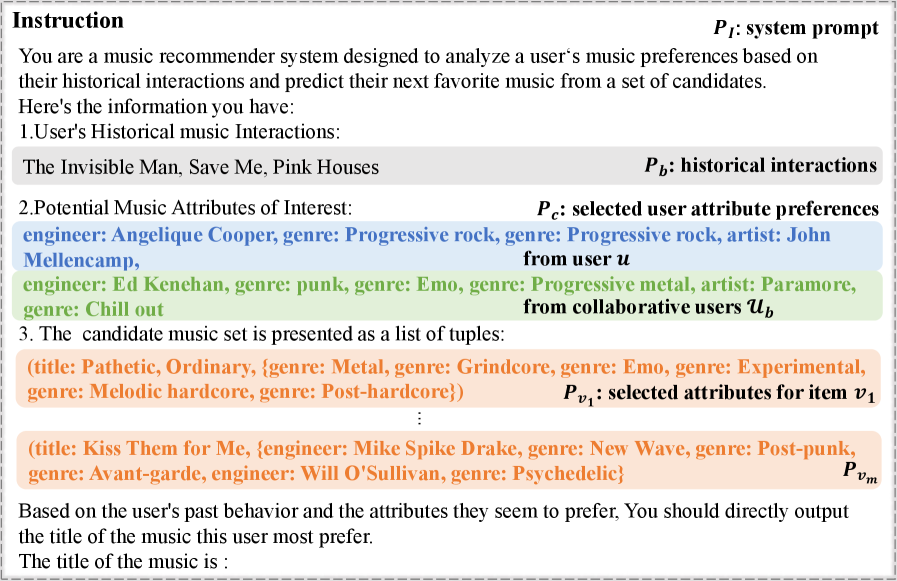
- Instance-wise Dual Attention: Uses a hard attention mechanism to select only the most credible attributes from both the user profile and candidate item, filtering out irrelevant noise before the LLM sees it
Architecture
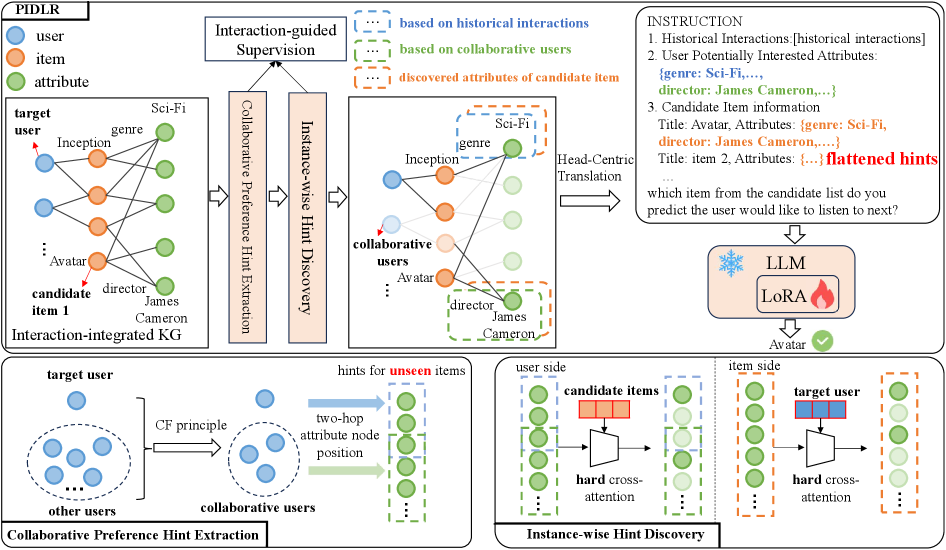
The overall PIDLR framework, detailing the flow from Knowledge Graph to LLM Input.
Evaluation Highlights
- Achieves an average relative improvement of over 3.02% against baselines on both pair-wise and list-wise recommendation tasks
- Outperforms strong LLM-based baselines like TALLRec and CoLLM across MovieLens-1M and Book-Crossing datasets
- Ablation studies confirm that the collaborative hint mechanism specifically addresses sparsity, improving performance where direct historical matches are missing
Breakthrough Assessment
7/10
Solid contribution addressing the specific 'sparsity vs. noise' trade-off in LLM4Rec. The explicit extraction of 'hints' bridge the gap between CF signals and LLM reasoning effectively.