📝 Paper Summary
Feature Engineering for Recommender Systems
LLM Agents
AgenticTagger employs a multi-agent framework where an architect LLM builds a hierarchical vocabulary and annotator LLMs validate it against items, producing structured, low-cardinality features for recommender systems.
Core Problem
Existing LLM-based recommendation approaches either generate high-cardinality unstructured descriptions that lack global consistency or require specialized architectures, while traditional discrete features (IDs) lack semantic understanding.
Why it matters:
- Unstructured LLM outputs (free-form text) lead to vocabulary explosion, where descriptors appear rarely, making them useless for learning rigorous recommendation patterns
- Recommender systems generally require low-cardinality, structured features (like categories or IDs) to scale and perform effectively
- Current methods fail to leverage LLM reasoning to create globally consistent, mutually exclusive feature sets that fit downstream model constraints
Concrete Example:
When describing music, free-form LLM generation might label one song 'Blues music' and another 'Blues great hits' for the same concept. This inconsistency creates two separate, rare features instead of a single shared category, degrading the recommender model's ability to learn user preferences for 'Blues'.
Key Novelty
Multi-Agent Architect-Annotator Framework for Feature Mining
- Separates the 'global view' (vocabulary maintenance) from the 'local view' (item tagging) into two distinct agent roles
- Uses a parallelized feedback loop where 'Annotator' agents report coverage failures on specific items to an 'Architect' agent, which iteratively refines the global descriptor hierarchy
Architecture
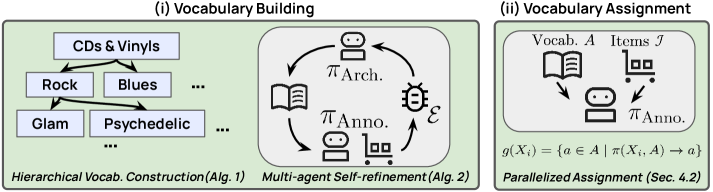
The AgenticTagger framework workflow, illustrating the two main stages: Vocabulary Building and Vocabulary Assignment.
Evaluation Highlights
- Achieves good performance with only 3-6 layers of hierarchical features across public benchmarks
- Demonstrates consistent improvements in generative recommendation and ranking scenarios compared to baselines (Semantic IDs, raw text)
- Maintains performance even when branching factor is constrained to 1 (assigning an item to a single feature per layer)
Breakthrough Assessment
7/10
Novel application of agentic workflows to feature engineering (a typically manual or purely statistical process). While results are claimed to be superior, the reliance on complex agent loops may impact latency/cost.