📝 Paper Summary
Recommender Systems
Large Language Models (LLMs) for Recommendation
A hybrid framework combines LLM-based high-level interest planning with classic item-level recommendation models to explore novel user interests while maintaining industrial scalability.
Core Problem
Traditional recommendation systems reinforce feedback loops by recommending items similar to past behavior, limiting the discovery of novel interests and leading to content fatigue.
Why it matters:
- Strong feedback loops in classic systems prevent users from discovering diverse content, reducing long-term engagement
- Directly using LLMs for large-scale recommendation is prohibitively expensive (latency/cost) and lacks domain-specific knowledge of rapidly evolving item corpuses
- Off-the-shelf LLMs fail to capture domain-specific collaborative signals and user behavior patterns required for effective personalization
Concrete Example:
A user who watches cooking videos keeps getting cooking recommendations due to feedback loops. An LLM might suggest 'travel vlogs' as a novel interest, but without grounding, it cannot efficiently map this broad concept to specific, high-quality video items in a corpus of billions.
Key Novelty
Hybrid Hierarchical Planning with Interest Clusters
- Use LLMs as a high-level planner to generate 'interest clusters' (novel topics) based on user history, rather than predicting individual items directly
- Ground these high-level interests by restricting a classic transformer-based recommender to only select items from the LLM-predicted clusters
- Represent user history and future interests using 'cluster descriptions' (keywords) rather than item IDs to enable efficient offline LLM inference via lookup tables
Architecture
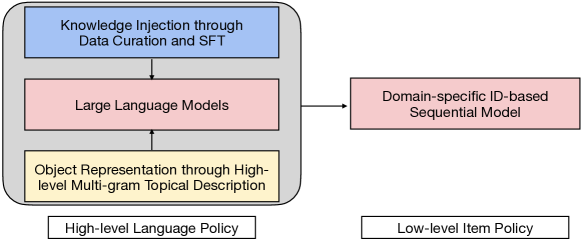
The Hybrid Hierarchical Planning framework. It illustrates the separation between High-level Language Policy (LLM) and Low-level Item Policy (Classic Model).
Evaluation Highlights
- Live experiments on a commercial platform with billions of users showed a significant increase in exploration of novel interests
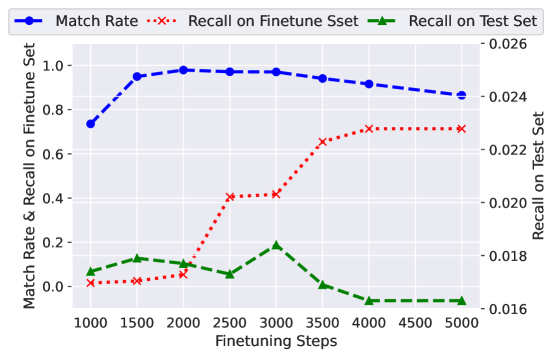
- Fine-tuned LLMs achieved >99% match rate in generating valid interest cluster descriptions after ~2,000 steps
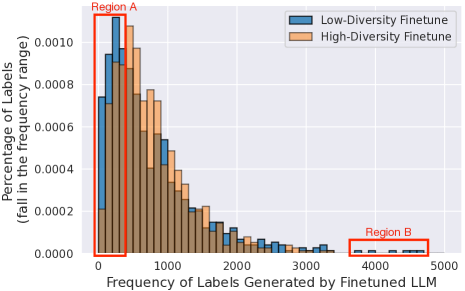
- Diversified data curation for fine-tuning eliminated long-tail distribution issues, ensuring broader interest exploration compared to random sampling
Breakthrough Assessment
8/10
Successfully deploys LLMs in a billion-user industrial system by solving the latency bottleneck via offline cluster planning. A practical architectural bridge between LLM reasoning and classic ID-based recommendation.