CoLLM integrates collaborative information into LLMs by mapping user/item embeddings from a conventional collaborative filtering model into the LLM's token space via an MLP.
Core Problem
Existing LLM-based recommenders rely heavily on text semantics and struggle to capture collaborative information (user-item interaction patterns), leading to suboptimal performance for warm-start users/items.
Why it matters:
Pure text-based LLMs miss crucial behavioral patterns hidden in interaction history that text descriptions alone cannot capture
Current methods fail to match traditional collaborative filtering models in warm-start scenarios where interaction data is rich
Directly learning ID embeddings in LLMs reduces scalability and compression rates due to tokenization redundancy
Concrete Example:Two items with similar text descriptions (e.g., two sci-fi movies) might appeal to very different user groups based on interaction history. A standard LLM sees them as textually similar and misses the distinction, whereas CoLLM uses collaborative embeddings to differentiate them based on who actually consumed them.
Key Novelty
Collaborative Information as a Distinct Modality
Treats collaborative embeddings (from models like Matrix Factorization or LightGCN) as a separate modality, similar to how multimodal LLMs handle images
Maps these external embeddings into the LLM's input space using a lightweight MLP projector, rather than training ID embeddings from scratch within the LLM
Uses a two-step tuning process: first tuning the LLM with LoRA for general recommendation capabilities, then tuning the mapping module to align collaborative signals
Architecture
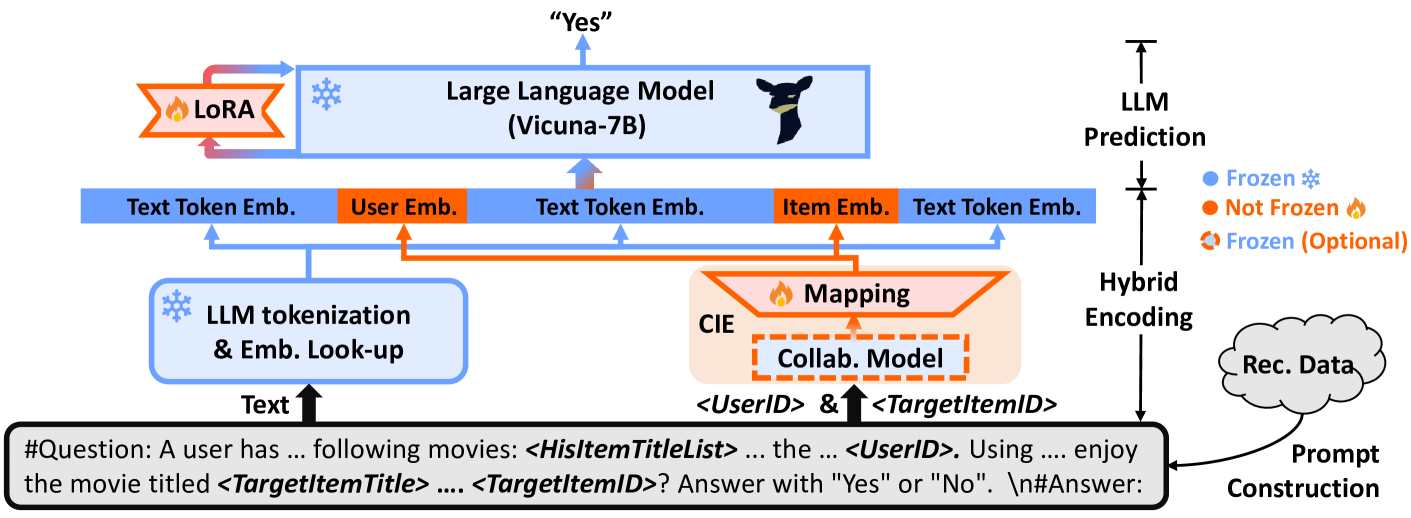
The CoLLM model architecture detailing the flow from prompt construction to prediction.
Evaluation Highlights
Outperforms TALLRec by substantial margins in warm-start scenarios (e.g., +69.9% improvement on Yelp dataset)
Surpasses traditional collaborative baselines like LightGCN in cold-start scenarios where interaction data is scarce
Achieves superior performance with significantly fewer trainable parameters compared to full fine-tuning approaches
Breakthrough Assessment
7/10
Effective bridging of the gap between semantic-rich LLMs and interaction-rich collaborative filtering. The 'collaborative as modality' approach is a smart architectural choice that preserves LLM scalability.
⚙️ Technical Details
Problem Definition
Setting: Predicting user preference y (1 or 0) for a target item i given user u, utilizing both interaction history D and textual information
Inputs: User u, Item i, Interaction history D, Item titles
Outputs: Prediction probability of answering 'Yes' (interaction likelihood)
Pipeline Flow
Prompt Construction (Templates with ID placeholders)
Hybrid Encoding (Text Tokenization + CIE Module)
LLM Prediction (Vicuna-7B with LoRA)
System Modules
Prompt Constructor
Creates input prompts containing item titles and placeholders for UserID/TargetItemID
Model or implementation: Template-based string formatting
LLM Tokenizer (Hybrid Encoding)
Converts textual parts of the prompt into token embeddings
Model or implementation: Vicuna-7B Tokenizer
CIE Module (Collaborative Information Encoding) (Hybrid Encoding)
Extracts collaborative embeddings and maps them to LLM space
Model or implementation: Conventional Collaborative Model (e.g., MF or LightGCN) + MLP Mapping Layer
LLM Prediction
Processes hybrid sequence of text and collaborative embeddings to generate prediction
Model or implementation: Vicuna-7B (frozen) + LoRA adapters
Novel Architectural Elements
Integration of a Collaborative Information Encoding (CIE) module as a distinct modality encoder (similar to visual encoders in multimodal LLMs)
Hybrid input sequence combining standard text token embeddings with mapped collaborative embeddings at specific placeholder positions
Modeling
Base Model: Vicuna-7B
Training Method: Two-step tuning: (1) LoRA tuning on text-only data, (2) CIE module tuning on hybrid data
Objective Functions:
Purpose: Tune LoRA adapters to learn recommendation task using text only.
Formally: Binary Cross Entropy loss on prediction y vs label
Formally: Binary Cross Entropy loss minimizing prediction error using full hybrid prompt
Adaptation: LoRA (Low-Rank Adaptation)
Trainable Parameters: LoRA weights and CIE module (MLP mapping layer + optional collaborative model parameters)
Key Hyperparameters:
LoRA_rank: Not reported in the paper
LLM_embedding_dim: 4096 (implied for 7B models)
mapping_mlp_structure: Linear -> Activation -> Linear (dimensions d1 -> d2)
Compute: Not reported in the paper
Comparison to Prior Work
vs. TALLRec: CoLLM explicitly injects collaborative embeddings, whereas TALLRec relies solely on text semantics
vs. BIGRec: CoLLM integrates collaborative info into the LLM's generation process (input space), whereas BIGRec ensembles outputs [not cited in paper but mentioned in related work text]
vs. Concurrent works (e.g., learning ID embeddings): CoLLM maps existing collaborative embeddings, avoiding the scalability and redundancy issues of learning new ID tokens from scratch
Limitations
Dependence on the quality of the external collaborative model; poor collaborative embeddings limit performance
Inference efficiency is lower than traditional lightweight models due to the heavy LLM backbone
Two-step tuning process is slightly more complex than single-stage end-to-end training
Code is publicly available at https://github.com/zyang1580/CoLLM. Implementation details of the CIE module (MLP structure) and specific LoRA hyperparameters are mentioned generally but exact values (rank, alpha) are not explicitly detailed in the text.
📊 Experiments & Results
Evaluation Setup
Top-K Recommendation and CTR prediction using historic interaction data
Benchmarks:
Yelp (Business Recommendation)
Amazon-Beauty (Product Recommendation)
Metrics:
Recall@20
NDCG@20
Statistical methodology: Not explicitly reported in the paper
Main Takeaways
CoLLM significantly outperforms text-only LLMRec baselines (like TALLRec) in warm-start scenarios, proving the value of collaborative embeddings.
In cold-start scenarios, CoLLM outperforms traditional models (like LightGCN) by leveraging the LLM's semantic understanding.
The approach is model-agnostic regarding the collaborative encoder; it works with both MF and LightGCN embeddings.
Ablation studies show that fine-tuning the collaborative model alongside the mapping layer (joint training in step 2) yields better results than keeping it fixed.