📝 Paper Summary
Recommender Systems (RS)
Large Language Models (LLM)
LLM Agents
Recommender systems are evolving along two distinct paths—enhancing list-wise accuracy and enabling conversation—which naturally converge at LLM-based agents that maximize information effectiveness while minimizing user interaction effort.
Core Problem
A fundamental dilemma exists between information effectiveness and user acquisition cost: getting accurate recommendations requires rich user feedback, but providing such feedback (e.g., via multi-turn text) imposes a high burden on users.
Why it matters:
- Simple feedback signals like clicks are sparse and noisy, often failing to reflect complex human intent in conventional deep learning models
- Conversational systems improve intent understanding but frustrate users with high interaction costs (typing, reading)
- Prior surveys overlook the convergence of list-wise and conversational paradigms toward autonomous agents
Concrete Example:
A conventional music recommender might guess a user's interest based on clicks, failing to capture specific moods. A conversational system could ask 'What do you want?', which is accurate but tedious. The paper argues an Agent could infer the mood and actively fetch heterogeneous info without verbose chatting.
Key Novelty
Unified Evolutionary Trajectory of Recommender Systems
- Proposes a 'panoramagram' mapping RS evolution on two axes: Information Effectiveness vs. User Acquisition Cost
- Identifies two paths: the 'List-wise' path (improving ranking models) and the 'Conversational' path (improving interaction)
- Posits that both paths converge at 'LLM Agents', which utilize tool intelligence and reflection to achieve high accuracy with low user effort
Architecture
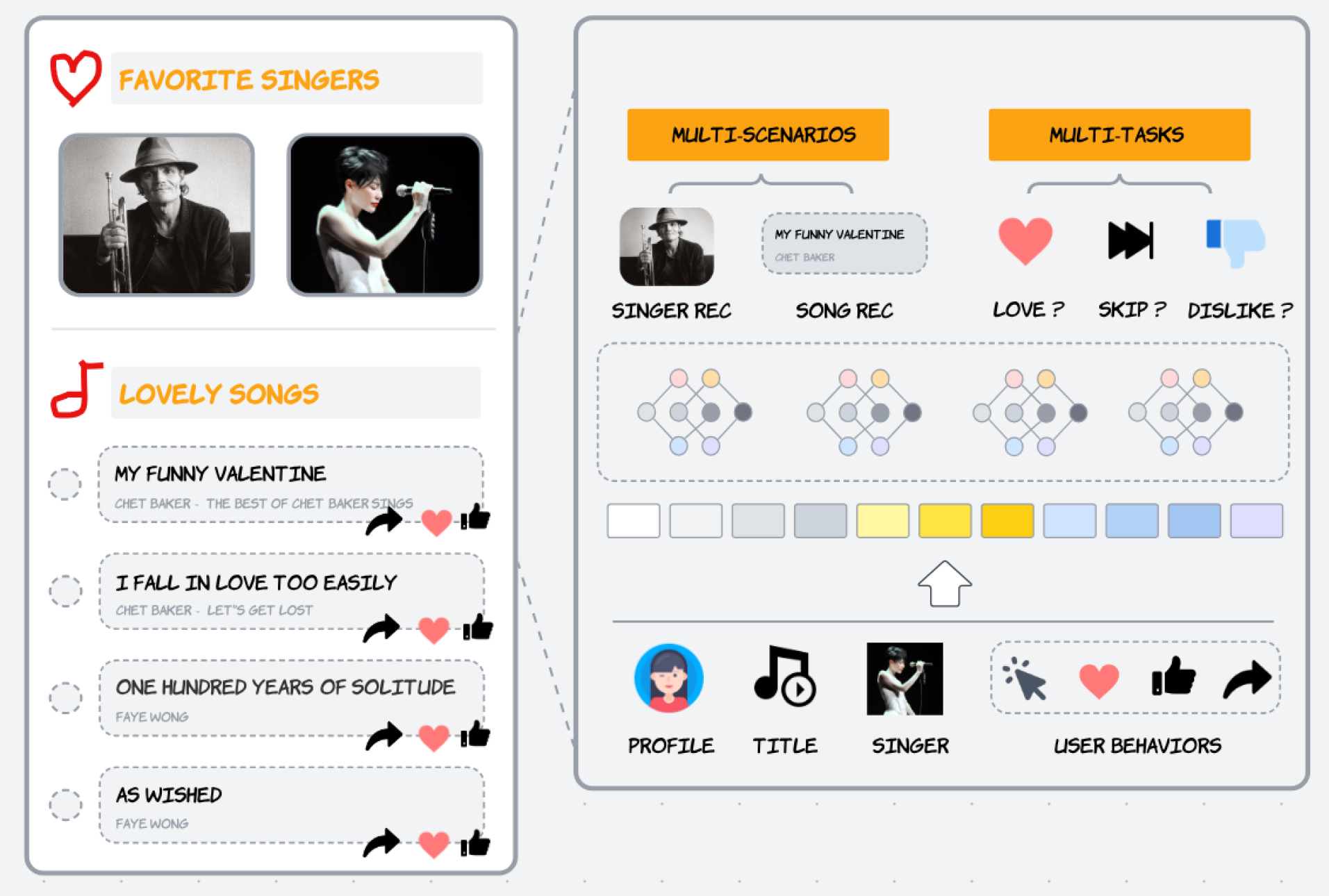
A typical process of conventional list-wise music recommender systems
Breakthrough Assessment
6/10
A comprehensive survey and vision paper. While it doesn't propose a specific new SOTA model, its taxonomy and 'convergence to agents' framework provide a strong conceptual roadmap for the field.