📝 Paper Summary
Memory organization
Web agents
HMT structures web agent memory into a hierarchy of intents, stages, and actions to decouple transferable planning logic from site-specific execution details, preventing failures on unseen websites.
Core Problem
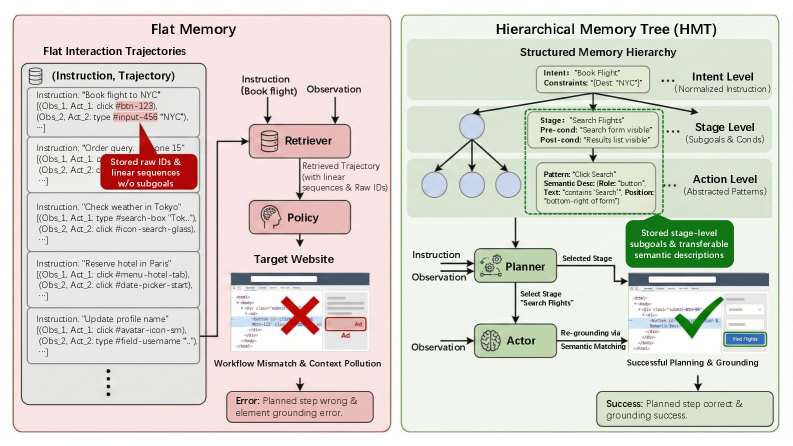
Retrieval-based web agents typically use flat memory structures that entangle high-level task logic with site-specific action details (like element IDs), causing failures when transferred to new websites.
Why it matters:
- Current agents fail to generalize across websites because they try to execute actions grounded in the specific HTML structure of previous sites
- Flat memory retrieval leads to 'intention-execution entanglement,' where correct high-level intents are paired with invalid low-level execution parameters
- Workflow mismatch occurs when agents retrieve actions that are functionally correct for the task but sequentially invalid for the current page state
Concrete Example:
An agent retrieving a memory to 'click search' might attempt to click a button with ID '#btn-123' from a previous site. On a new site where that ID doesn't exist, the agent fails, even though the intent to 'click search' is correct.
Key Novelty
Hierarchical Memory Tree (HMT)
- Deconstructs interaction trajectories into three levels: Intent (user goals), Stage (semantic subgoals with pre/post-conditions), and Action (abstract patterns without raw IDs)
- Replaces site-specific element identifiers (e.g., DOM IDs) with 'semantic element descriptions' (e.g., 'button labeled Search') to allow grounding on new page layouts
- Uses a 'Planner-Actor' inference scheme where the Planner verifies visual pre-conditions to match the logical stage, and the Actor grounds abstract descriptions to local elements
Architecture
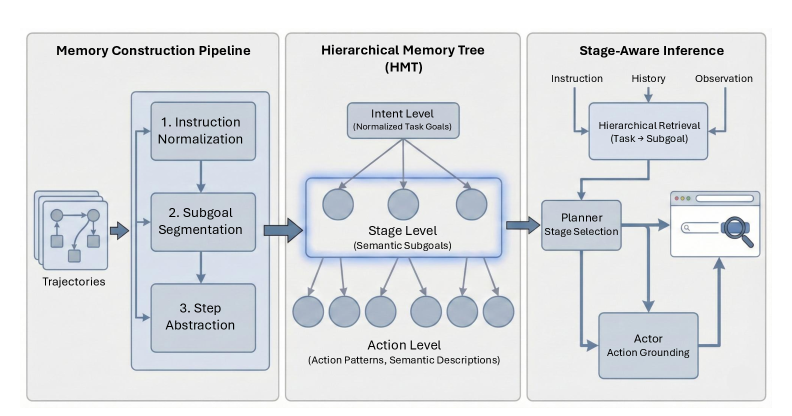
Overview of the HMT framework, showing the offline memory construction pipeline (left) and the online stage-aware inference process (right).
Evaluation Highlights
- +9.4% improvement in Task Success Rate on Mind2Web Cross-Website split compared to AWM (online), showing strong generalization to unseen sites
- +6.6% improvement in Total Success Rate on WebArena compared to a Flat Retrieval baseline, effectively mitigating intention-execution entanglement
- Outperforms state-of-the-art AWM agent by 3.2% on WebArena, with significant gains in the 'Maps' (+10.4%) and 'GitLab' (+5.8%) domains
Breakthrough Assessment
8/10
Addresses a critical bottleneck in web agent generalization (ID dependency) with a logically sound hierarchical abstraction. Significant empirical gains on major benchmarks confirm the validity of decoupling logic from execution.